
What's Happening?
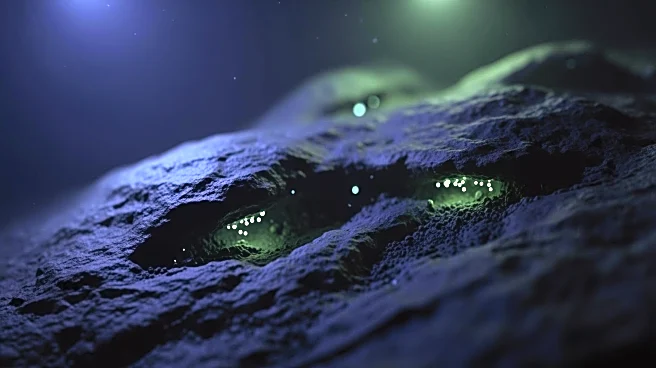
A team of scientists has uncovered a diverse group of microbes, referred to as 'intraterrestrials,' living deep beneath Earth's surface in marine sediments. These microorganisms are capable of surviving in extreme conditions and can remain dormant for
thousands to millions of years. The research, highlighted in Karen G. Lloyd's book 'Intraterrestrials: Discovering the Strangest Life on Earth,' explores how these microbes adapt to their environment and the evolutionary mechanisms that allow them to exist in a non-growing state for extended periods. The study suggests that these microbes are specially adapted to the subsurface environment, with enzymes tailored to the available substrates, indicating a unique evolutionary path distinct from surface-dwelling organisms.
Why It's Important?
The discovery of these intraterrestrial microbes challenges traditional views of evolution and adaptation, suggesting that life can persist in a dormant state for geological timescales. This finding has significant implications for our understanding of life's resilience and adaptability, potentially informing studies on life's origins and the search for extraterrestrial life. The ability of these microbes to survive without reproducing for extended periods raises questions about the mechanisms of natural selection and adaptation in extreme environments. This research could also impact fields such as biotechnology and astrobiology, where understanding extremophiles can lead to new technologies and insights into life's potential on other planets.
What's Next?
Future research will likely focus on further exploring the genetic and metabolic pathways that enable these microbes to survive in such extreme conditions. Scientists may also investigate the potential applications of these findings in biotechnology, such as developing new enzymes or bioengineering organisms for industrial processes. Additionally, this research could guide astrobiologists in identifying potential biosignatures of life on other planets, particularly those with harsh environments similar to Earth's subsurface. Collaborative efforts between geologists, biologists, and astrobiologists will be crucial in advancing our understanding of these unique life forms and their implications for life beyond Earth.
Beyond the Headlines
The existence of intraterrestrial microbes raises philosophical and ethical questions about the definition of life and the criteria for its existence. It challenges the notion of life as a dynamic, reproducing entity, suggesting that life can also be characterized by its ability to endure and adapt over vast timescales. This discovery may prompt a reevaluation of how we define and study life, both on Earth and in the cosmos. It also highlights the importance of preserving Earth's diverse ecosystems, as they may hold clues to life's fundamental properties and potential resilience in the face of environmental changes.