






What's Happening?
Researchers have discovered a vast network of basins beneath Antarctica's ice, termed the East Antarctic Fan-Shaped Basin Province (EAFBP). This finding, published in Nature Geoscience, was led by geophysicist Egidio Armadillo from the University of Genoa.
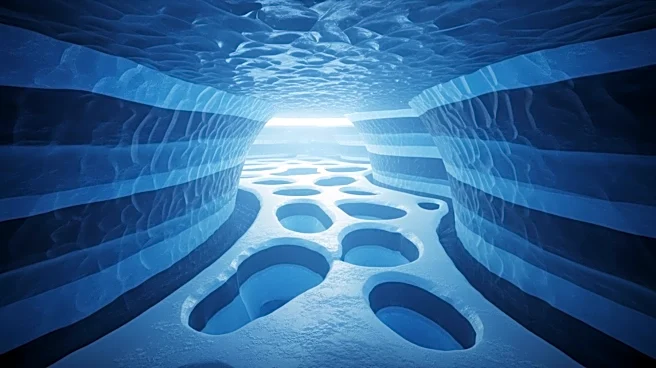
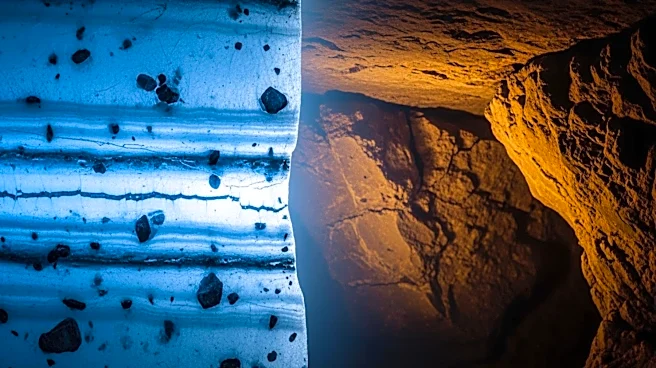
The EAFBP connects previously known basins like Wilkes and Aurora, as well as Lake Vostok, into a larger subterranean structure. The discovery was made possible by integrating decades of seismic, subglacial topography, and radar data with models simulating the land's response if the ice were removed. This revealed a pattern of basins radiating from a central point near the South Pole, suggesting formation through rotational extension, where the Earth's crust stretches and rotates around a focal point.
Why It's Important?
Understanding the EAFBP is crucial for predicting ice flow across Antarctica, especially as climate change impacts the continent's ice sheets. The basins, located beneath half of the East Antarctic ice sheet, influence how ice moves, as it follows the bedrock's grooves. This knowledge is vital for anticipating changes in ice movement due to climate change, which could have significant implications for global sea levels. The research provides a baseline for understanding current ice dynamics, aiding in future climate models and environmental planning.
What's Next?
Future research will likely focus on further exploring the EAFBP's impact on ice dynamics and its role in the broader Antarctic ecosystem. Scientists may conduct more detailed studies using advanced technologies to refine models of ice movement and predict future changes. This could involve international collaborations to monitor the region's response to climate change, providing data to inform global climate policy and mitigation strategies.
Beyond the Headlines
The discovery of the EAFBP highlights the importance of technological advancements in geophysical research. It underscores the need for continued investment in scientific exploration to uncover hidden geological features that can influence global environmental systems. The findings also raise questions about the potential for undiscovered structures beneath other ice-covered regions, which could further alter our understanding of Earth's geological history and climate dynamics.