



What's Happening?
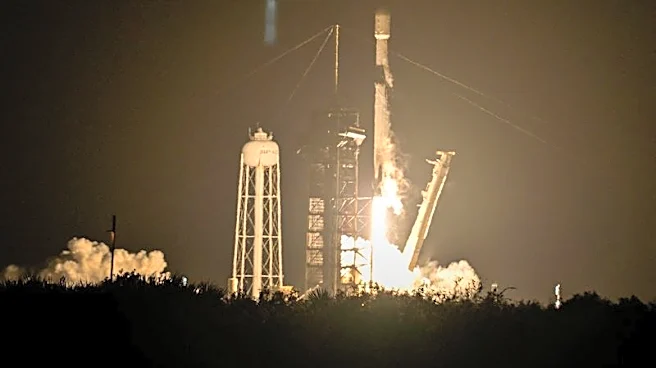
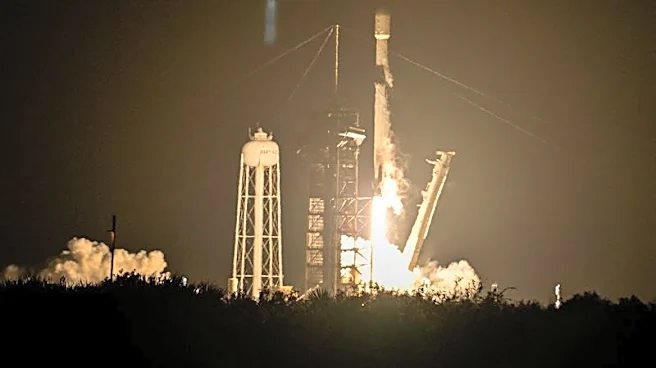
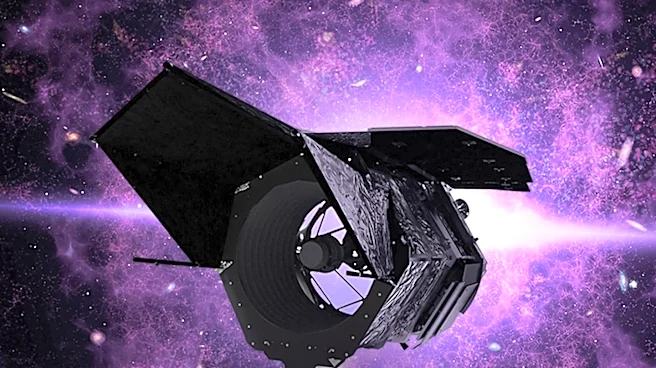
NASA's Nancy Grace Roman Space Telescope is set to launch on a SpaceX Falcon Heavy rocket from Kennedy Space Center on August 30, 2026, eight months ahead of its original May 2027 target. The telescope is designed to survey vast areas of the sky with
a large field of view and crisp infrared vision. It aims to explore cosmic topics such as dark energy, dark matter, and exoplanets. By the end of its five-year primary mission, the Roman Space Telescope is expected to amass a 20,000-terabyte data archive, enabling scientists to study 100,000 exoplanets, hundreds of millions of galaxies, billions of stars, and rare cosmic phenomena.
Why It's Important?
The early launch of the Nancy Grace Roman Space Telescope represents a significant advancement in astronomical research capabilities. Its ability to survey large portions of the sky with high precision will provide unprecedented opportunities for scientists to explore fundamental cosmic questions. The data collected could lead to breakthroughs in understanding dark energy and dark matter, which are critical to comprehending the universe's expansion and structure. Additionally, the telescope's findings on exoplanets could enhance our knowledge of planetary systems beyond our own, potentially identifying habitable worlds.
What's Next?
Following its launch, the Roman Space Telescope will begin its mission to collect data over a five-year period. Scientists and researchers will analyze the vast data archive to identify and study various cosmic phenomena. The telescope's findings are expected to influence future space missions and research priorities, potentially leading to new theories and models in astrophysics. The scientific community will likely engage in collaborative efforts to maximize the telescope's data, fostering international partnerships and advancing global astronomical knowledge.