



What's Happening?
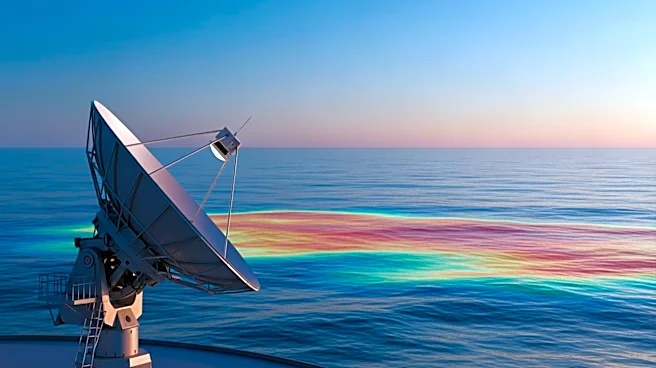
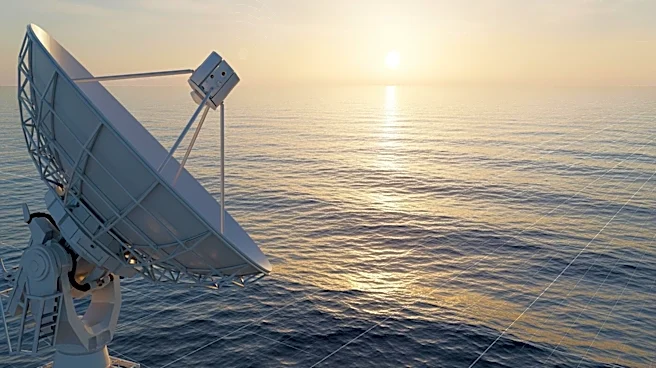
Researchers from Florida State University, in collaboration with other institutions, have developed a new modeling framework that significantly improves the precision of ocean surface measurements from NASA's Surface Water and Ocean Topography (SWOT)
satellite. This advancement addresses the challenge of internal tides, which are subsurface waves that interfere with satellite observations. By using the Hybrid Coordinate Ocean Model (HYCOM), the team can accurately model these internal tides, allowing for a clearer understanding of ocean circulation. The new method has shown a 59% improvement in correcting internal tide noise, enhancing the ability to track oceanic features crucial for climate studies.
Why It's Important?
This development is crucial for climate science as it enhances the accuracy of satellite data used to study ocean circulation, which plays a vital role in regulating the Earth's climate. Improved measurements allow scientists to better understand how the ocean absorbs atmospheric heat and carbon dioxide, which is essential for predicting climate change impacts. Additionally, the enhanced data supports operational forecasting in weather prediction, marine navigation, and coastal planning, providing significant benefits to various sectors reliant on accurate ocean data.
What's Next?
The integration of real-time ocean modeling with continuous satellite monitoring is expected to advance Earth system science, offering improved insights into the ocean's role in climate regulation. This could lead to better predictions of marine heatwaves, optimized shipping routes, and more effective fisheries management. The collaboration between oceanographers, remote sensing specialists, and computational scientists exemplifies the potential of interdisciplinary efforts to overcome challenges in remote ocean observation.
Beyond the Headlines
The successful correction of internal tide interference marks a significant step in unveiling the ocean's hidden dynamics from space. As the ocean continues to absorb heat and carbon dioxide, understanding the currents and eddies that facilitate this exchange becomes increasingly important. This research highlights the value of international cooperation in expanding scientific knowledge and developing adaptive strategies to protect ocean health and human societies dependent on marine environments.