







What's Happening?
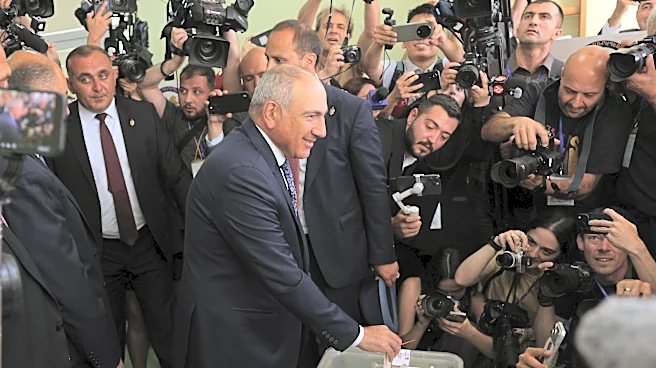
Armenian Prime Minister Nikol Pashinyan has declared victory in the country's general election, which was viewed as a significant test of Russia's influence in the region. Preliminary results indicate that Pashinyan's Civil Contract party secured 49.82%
of the vote, significantly ahead of the runner-up, the Strong Armenia bloc, which garnered 23.28%. The election was marked by accusations of Russian interference, with the opposition alleging that Moscow attempted to sway the outcome. Despite these claims, the election was deemed free and fair by local analysts. The results suggest a shift in Armenia's geopolitical stance, with Pashinyan advocating for closer ties with the European Union and a move away from Russian influence.
Why It's Important?
The election results are pivotal for Armenia's future political and economic direction. Pashinyan's victory could lead to a realignment of Armenia's foreign policy, potentially reducing Russian influence in the region. This shift may have significant implications for Armenia's economy, as Russia controls a substantial portion of its energy and infrastructure. The European Union has expressed support for Armenia's democratic reforms, which could lead to increased economic cooperation and investment. However, Russia has warned of economic consequences if Armenia continues to distance itself from Moscow, highlighting the geopolitical tensions at play.
What's Next?
Following the election, Pashinyan's government is expected to pursue a peace process with neighboring Azerbaijan, focusing on border demarcation and reducing corruption. The government aims to institutionalize a peace deal, potentially creating a major transit corridor through Armenia. This initiative could transform Armenia into a strategic crossroads between Europe and Central Asia. The European Union is preparing an economic support package for Armenia, while Russia's response remains cautious, with potential increased pressure on Pashinyan's government.
Beyond the Headlines
The election underscores the broader geopolitical struggle between Western and Russian influences in the South Caucasus. Armenia's pivot towards the EU could serve as a model for other post-Soviet states seeking to balance relations between major powers. The situation also highlights the challenges of maintaining national sovereignty amid external pressures. The outcome may influence regional stability, particularly in the context of Armenia's ongoing conflict with Azerbaijan over the Nagorno-Karabakh region.