
What's Happening?
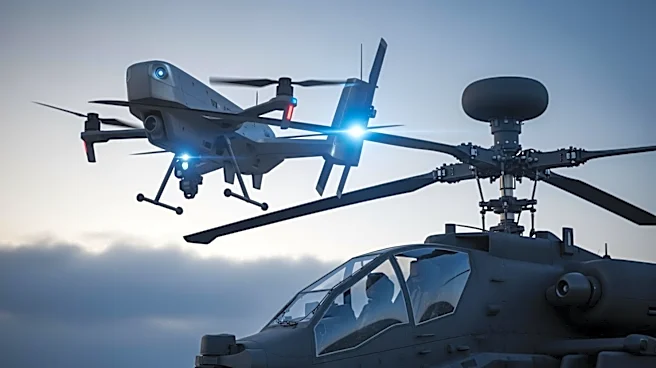
The UK Ministry of Defence (MoD) has selected four companies to advance the development of autonomous drones designed to operate alongside British Army Apache attack helicopters. The companies chosen are
BAE Systems, Anduril Industries' UK branch, Tekever of Portugal, and Thales UK. These companies were selected from an initial group of seven suppliers, which included Leonardo and Lockheed Martin UK, following a pre-qualification phase. The selected companies will share a £10 million ($13.3 million) fund to develop uncrewed air systems (UAS) as part of Project NYX. These drones, referred to as 'loyal wingmen,' are intended to perform functions such as reconnaissance, precision strike, target acquisition, and electronic warfare autonomously, while human operators will retain control over weapon use. The MoD plans to work closely with these partners to refine their technologies, with the aim of advancing up to two designs to the prototype stage by autumn 2026.
Why It's Important?
This initiative is significant as it aligns with the UK Ministry of Defence's strategic focus on integrating autonomous technology into military operations. The development of these 'loyal wingmen' drones could enhance the operational capabilities of the British Army's Apache helicopters by providing additional support in reconnaissance and combat scenarios without increasing the risk to human pilots. The project reflects a broader trend in military strategy towards the use of autonomous systems, which can offer strategic advantages such as increased operational efficiency and reduced human risk. Successful implementation of this technology could set a precedent for future military innovations and influence defense strategies globally.
What's Next?
The MoD plans to continue collaborating with the selected companies to further assess and refine their drone technologies. By autumn 2026, the ministry aims to advance up to two of the most promising designs to the prototype stage. If these prototypes demonstrate operational potential, the goal is to have a system ready for service with the British Army by 2030. This timeline indicates a structured approach to integrating autonomous systems into military operations, with potential implications for future defense procurement and strategy.