


What's Happening?
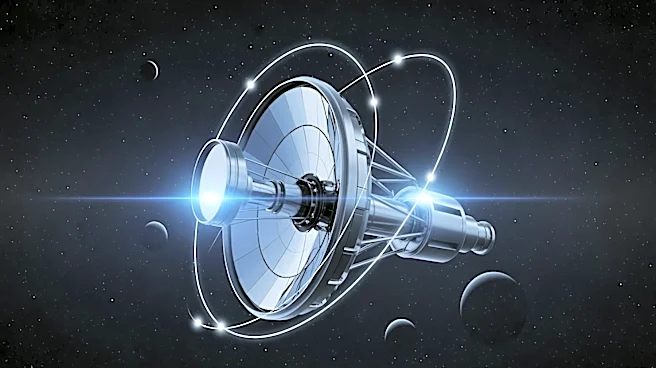
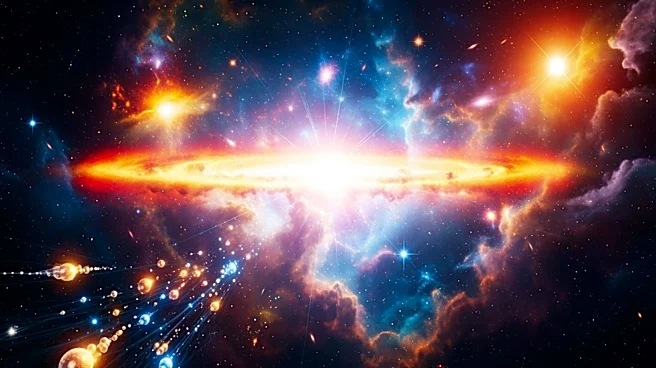
The James Webb Space Telescope has achieved a groundbreaking discovery by identifying the most chemically primitive galaxy in the early universe. This galaxy, known as LAP1-B, existed 800 million years after the Big Bang and is characterized by its extremely
low metal content. The discovery was made possible through Webb's advanced infrared instruments and spectrometers, which allowed scientists to peer into the Epoch of Reionization, a period marked by the universe's transition from neutral hydrogen to ionized states. The research, led by Associate Professor Kimihiko Nakajima, provides insights into the formation of the first generation of stars and the subsequent seeding of heavier elements in the universe.
Why It's Important?
This discovery is pivotal for understanding the early stages of galaxy formation and the evolution of the universe. By identifying a galaxy with such primitive chemical composition, astronomers can trace the origins of heavier elements that are essential for life. The findings offer a direct link to the 'cosmic fossils' found near the Milky Way, providing a clearer picture of how ancient galaxies have survived to the present day. This research enhances our knowledge of cosmic history and the processes that led to the development of complex structures in the universe.
What's Next?
The research team plans to use the James Webb Space Telescope to search for even more chemically primitive objects, including the very first galaxies ever formed. These efforts will deepen our understanding of the universe's chemical evolution and the formation of its oldest structures. The ongoing study will continue to refine models of galaxy formation and contribute to the broader field of cosmology.