


What's Happening?
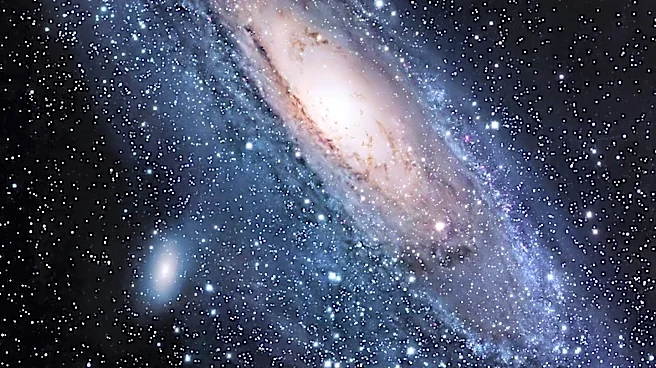
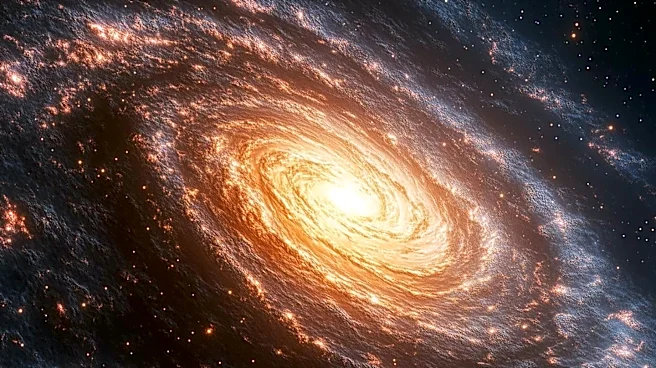
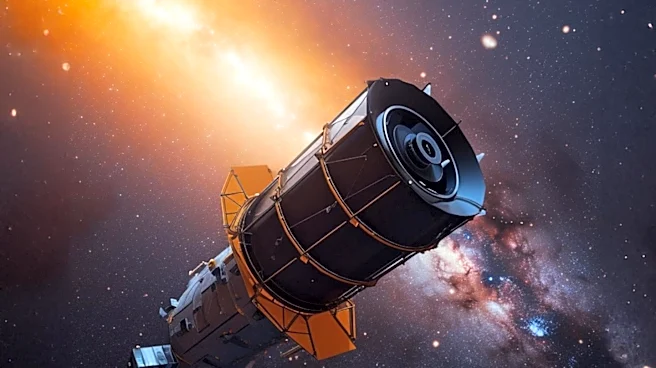
Astronomers have successfully measured the full size of IC 1101, the largest known galaxy, using deep images from the Wide Field Camera on the Isaac Newton Telescope. The galaxy extends approximately 520 kiloparsecs, or about 1.7 million light-years,
and contains roughly 3.4 trillion solar masses in stars. This measurement confirms IC 1101 as the largest galaxy, significantly surpassing the Milky Way in both size and mass. The study also detected faint stellar structures beyond the galaxy's main boundary, indicating ongoing growth through accretion.
Why It's Important?
Understanding the size and growth of IC 1101 provides insights into galaxy formation and evolution. As a brightest cluster galaxy (BCG), IC 1101's growth through mergers offers a glimpse into the hierarchical nature of galaxy formation. This research helps astronomers understand the dynamics of galaxy clusters and the role of BCGs in the cosmic structure. The findings also contribute to the study of dark matter distribution and its influence on galaxy formation, enhancing our knowledge of the universe's large-scale structure.
What's Next?
Future research will focus on further exploring the outskirts of IC 1101 and its ongoing mass assembly. This includes studying the interactions between the galaxy and its surrounding intracluster medium. Continued observations and advanced modeling techniques will help refine our understanding of galaxy growth and the processes driving it. Additionally, the study of similar galaxies could provide comparative data, offering a broader perspective on the evolution of massive galaxies in the universe.