





What's Happening?
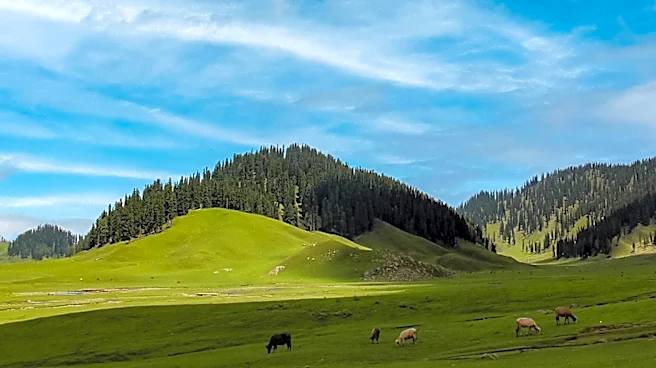
A herd of approximately 25 cattle inadvertently entered Yellowstone National Park earlier this week, grazing in an area where commercial livestock grazing has been banned for over 120 years. The cattle, which were privately owned and being grazed under
a federal permit on the Caribou-Targhee National Forest, wandered into the park due to a fencing failure. Adam Bronstein, Oregon director of the Western Watersheds Project, discovered the trespassing cattle. The U.S. Forest Service has since contacted the permittee, and efforts are underway to retrieve the cattle and repair the fence. This incident underscores the ongoing debate surrounding federal grazing permits on public lands, particularly in the Greater Yellowstone Ecosystem, where livestock grazing is permitted in surrounding areas but strictly prohibited within the national park boundaries.
Why It's Important?
This incident in Yellowstone National Park is significant because it highlights the persistent conflicts over land use and conservation in the American West. The ban on commercial livestock grazing in Yellowstone, established in the early 1900s, was a crucial measure to protect native wildlife, particularly bison, from competition and disease. The inadvertent entry of cattle, even if temporary, brings attention to the ecological risks, such as the potential spread of brucellosis, which has historically been a concern for both wildlife and livestock in the region. The incident also underscores the challenges of managing vast federal lands that border private and permitted grazing areas, where infrastructure failures like broken fences can have immediate environmental consequences. For conservation groups, it reinforces the need for stricter enforcement and better management of grazing allotments to protect sensitive ecosystems and wildlife habitats.
What's Next?
Following the retrieval of the cattle and the repair of the fence, the U.S. Forest Service will likely review the incident to prevent future occurrences. This could involve assessing the integrity of fencing along the park boundaries and potentially re-evaluating the conditions of federal grazing permits in adjacent areas. The Western Watersheds Project and other conservation organizations will likely continue to monitor grazing practices in the Greater Yellowstone Ecosystem, advocating for policies that prioritize wildlife protection and ecosystem health. The incident may also fuel ongoing legal and political debates regarding the balance between ranching interests and conservation efforts on federal lands. Discussions about the management of brucellosis, particularly concerning bison that venture outside the park, could also intensify, given the historical context of disease transmission between livestock and wildlife.
Beyond the Headlines
The presence of cattle in Yellowstone, even briefly, taps into a deeper historical narrative of land ownership, resource use, and the evolving understanding of conservation in the United States. The early 20th-century decision to ban grazing in Yellowstone was a landmark moment in the development of national park management, prioritizing ecological integrity over economic exploitation. This incident serves as a reminder that these historical decisions are not static but are continually challenged by contemporary land use pressures. It also highlights the complex interplay between federal agencies, private landowners, and environmental groups, each with differing stakes in how public lands are managed. The 'irony' of brucellosis, potentially introduced by cattle to bison historically and now used as a justification to manage bison outside the park, underscores the long-term consequences of human activities on natural ecosystems and the ethical dilemmas inherent in managing wildlife populations in a human-dominated landscape.