






What's Happening?
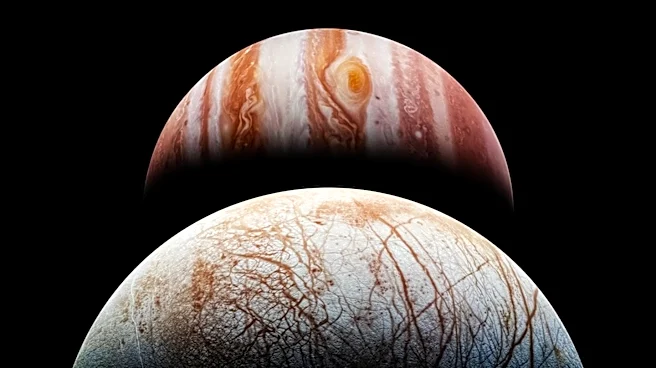
NASA's Europa Clipper mission is set to explore Europa, one of Jupiter's moons, which is believed to harbor a vast ocean beneath its icy surface. Scientists estimate that this ocean could contain twice as much water as all of Earth's oceans combined.
The mission aims to understand the nature of Europa's ice shell, the ocean beneath it, and the moon's overall composition and geology. The spacecraft will conduct nearly 50 flybys, using various instruments to study Europa's surface, interior, and thin atmosphere. This mission is significant as it seeks to determine whether Europa's subsurface ocean could support life, making it a key target in astrobiology.
Why It's Important?
The potential discovery of a subsurface ocean on Europa has significant implications for the search for extraterrestrial life. Liquid water is a crucial ingredient for life as we know it, and the presence of such a vast ocean increases the possibility of habitable conditions. The mission's findings could reshape our understanding of where life might exist beyond Earth. Additionally, the study of Europa's geological activity and its interaction with Jupiter's gravitational forces could provide insights into similar processes on other celestial bodies, enhancing our knowledge of planetary science.
What's Next?
The Europa Clipper mission, launched in 2024, will continue its flybys and data collection over the coming years. Scientists will analyze the data to assess the habitability of Europa's ocean and its potential to support life. The mission will also inform future exploration efforts, possibly leading to more targeted missions that could directly sample Europa's surface or subsurface. The results could influence the direction of astrobiological research and the prioritization of other celestial bodies for exploration.
Beyond the Headlines
Europa's exploration challenges traditional notions of habitability, as it suggests that life could exist in environments vastly different from Earth's. The mission underscores the importance of considering diverse planetary conditions when searching for life. Furthermore, the technological advancements required for the Europa Clipper mission could pave the way for more sophisticated space exploration tools, enhancing our ability to study distant worlds.