


What's Happening?
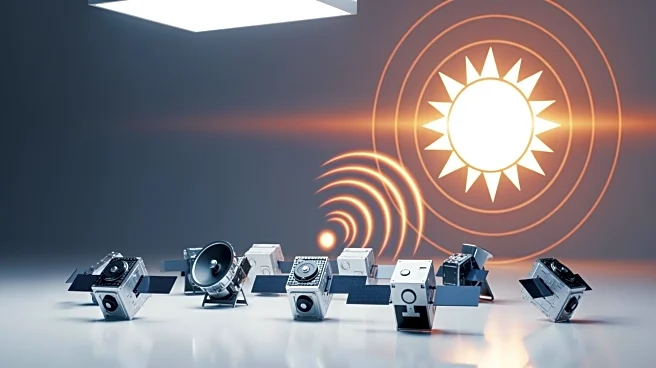
NASA's SunRISE mission, consisting of six SmallSats, has successfully completed vibration testing, moving closer to its launch. The mission aims to study solar radio bursts and map the Sun's magnetic field. The spacecraft will be launched from Cape Canaveral
Space Force Station aboard a United Launch Alliance Vulcan Centaur rocket. Once in orbit, the SmallSats will form a large radio telescope to detect solar radio bursts, contributing to the understanding of space weather and its effects on Earth.
Why It's Important?
The SunRISE mission is crucial for advancing our understanding of solar phenomena and their impact on space weather. By mapping the Sun's magnetic field and studying solar radio bursts, the mission will provide valuable data to help mitigate the effects of solar activity on satellites, communication systems, and power grids. This research is vital for protecting technological infrastructure and ensuring the safety of astronauts. The mission also represents a significant step in the use of SmallSats for complex scientific investigations, showcasing their potential for cost-effective space exploration.