






What's Happening?
Researchers at Northwestern University, in collaboration with the Institute of Light and Matter in Lyon, have published a study in Science detailing how the mantis shrimp's dactyl club withstands its incredibly powerful strikes. The mantis shrimp delivers
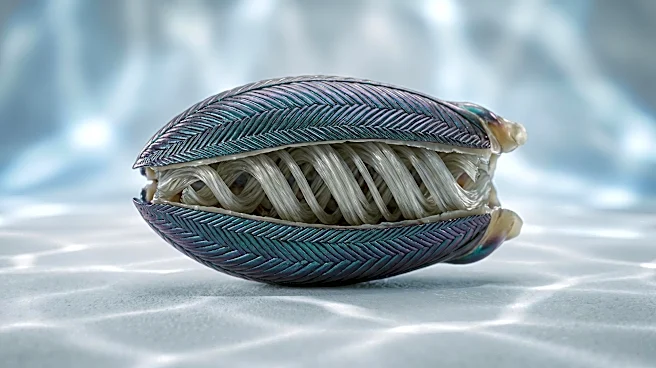
one of the fastest punches in the ocean, accelerating its club at a rate comparable to a .22 caliber bullet, creating a cavitation bubble that briefly reaches temperatures similar to the sun's surface. This dual impact, from the club and the collapsing bubble, is devastating to prey. The study, led by Nicolas Alderete and Horacio Espinosa, reveals that the club is not a solid mass but is composed of layers. An outer impact region of mineralized fibers arranged in a herringbone pattern resists cracking, while a deeper Bouligand structure, made of corkscrew-like fiber bundles, acts as a 'phononic shield.' This shield filters out high-frequency shockwaves that would otherwise damage the shrimp's soft tissues. The team used laser-based techniques, including transient grating spectroscopy and picosecond laser ultrasonics, to observe how stress waves propagate through the material, confirming the filtering effect of the Bouligand layer.
Why It's Important?
This research holds significant implications for materials science and engineering, particularly in the development of impact-resistant materials. The mantis shrimp's club, capable of enduring thousands of high-force strikes without shattering, presents a natural model for designing advanced protective gear and coatings. Understanding how biological structures manage extreme mechanical stress can lead to innovations in various U.S. industries, including defense, automotive, and construction. For instance, the 'phononic shield' concept, which filters out damaging vibrations, could inspire new designs for body armor, vehicle components, or even earthquake-resistant building materials. The ability to create materials that can self-protect against high-frequency shockwaves could enhance the durability and safety of numerous products, potentially reducing maintenance costs and extending product lifespans across a wide range of applications. This bio-inspired approach to material design could also foster new research avenues in biomimetics within academic and industrial sectors.
What's Next?
The current study primarily focused on 2D simulations of wave behavior within the club, and the researchers indicate that 3D simulations and more advanced underwater experiments are still needed to fully understand the mantis shrimp's mechanics. Future research will likely involve further detailed analysis of the Bouligand structure's properties and its potential for replication in synthetic materials. Materials scientists outside the study have already noted the potential for this structure to inspire impact-resistant coatings and protective gear, suggesting that the next steps will involve translating these biological principles into engineered designs. This could lead to the development of prototypes for new materials that mimic the shrimp's club, followed by rigorous testing to assess their performance and scalability for industrial applications. Collaboration between biologists, materials scientists, and engineers will be crucial in moving from biological observation to practical, real-world applications.
Beyond the Headlines
The mantis shrimp's club exemplifies nature's sophisticated engineering, offering a profound lesson in material design that goes beyond simple strength. The concept of a 'phononic shield' highlights a less obvious but critical aspect of material resilience: the ability to manage and dissipate energy at a microstructural level. This discovery challenges conventional approaches to impact protection, which often focus solely on material hardness or elasticity. Instead, it points towards the importance of structural geometry and layered composition in mitigating destructive forces. This could lead to a paradigm shift in how engineers approach material failure, moving towards designs that actively filter out harmful vibrations rather than merely absorbing them. The ethical implications of bio-inspired design also come into play, as researchers must carefully consider how to ethically extract and apply lessons from natural systems without exploiting or harming the organisms themselves. This ongoing exploration of biomimetics underscores the vast, untapped potential of the natural world to solve complex engineering challenges.