







What's Happening?
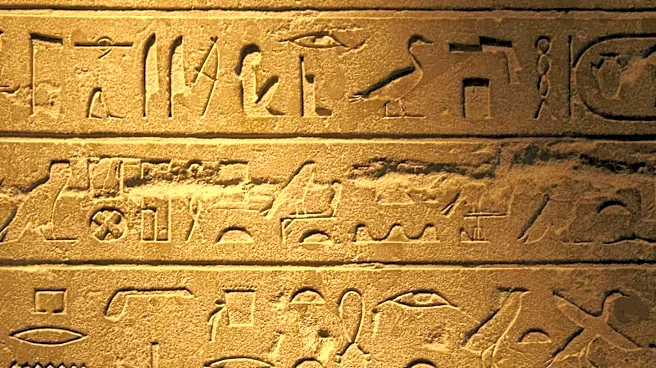
The Rosetta Stone, discovered in July 1799 during Napoleon's invasion of Egypt, proved instrumental in deciphering ancient Egyptian hieroglyphs. French soldiers found the stone in a fort near Rashid, a town Europeans called Rosetta. The stone contained
a decree inscribed in three scripts: hieroglyphs, demotic (everyday Egyptian script), and ancient Greek. Scholars were able to read the Greek text, which provided the key to understanding the other two scripts. At the time of its discovery, hieroglyphs had not been read for approximately 1,400 years. The French did not retain possession of the stone; it was handed over to the British in 1801 after their victory over the French army in Egypt and subsequently arrived at the British Museum the following year. The decoding process involved significant contributions from scholars like Thomas Young, who identified that royal names, such as Ptolemy, were spelled out phonetically within oval frames (cartouches). Jean-François Champollion, a French scholar proficient in Coptic, the last form of Egyptian, ultimately cracked the hieroglyphs in 1822, realizing that the script combined both sound signs and picture signs.
Why It's Important?
The decipherment of the Rosetta Stone revolutionized the understanding of ancient Egyptian civilization, culture, and history. Before its decoding, much of ancient Egypt's written records, religious texts, and historical accounts were inaccessible, leaving a significant gap in human knowledge. The ability to read hieroglyphs opened a window into the daily lives, beliefs, political structures, and scientific advancements of one of the world's earliest and most influential civilizations. This breakthrough allowed historians and archaeologists to interpret countless inscriptions on monuments, papyri, and artifacts, providing invaluable primary source material. The Rosetta Stone's impact extends beyond Egyptology, serving as a powerful symbol of linguistic and cultural unlocking. It underscored the importance of multilingual texts in historical research and laid the groundwork for modern epigraphy and the study of ancient languages. The knowledge gained from deciphering hieroglyphs has enriched global understanding of human development, art, religion, and governance, influencing academic disciplines and public interest in ancient history worldwide.
What's Next?
The Rosetta Stone continues to be a focal point for historical and linguistic study, with ongoing research into the nuances of ancient Egyptian language and its evolution. While the primary decipherment was completed in the 19th century, scholars still analyze the stone's inscriptions for deeper insights into the Ptolemaic period and the broader context of Egyptian history. The stone's presence in the British Museum also sparks ongoing discussions regarding cultural heritage and the repatriation of artifacts to their countries of origin. These debates often involve international cultural institutions and governments, highlighting complex ethical and legal considerations surrounding historical acquisitions. Furthermore, the story of the Rosetta Stone continues to inspire new generations of linguists, archaeologists, and historians, encouraging the pursuit of knowledge and the unlocking of ancient mysteries through interdisciplinary approaches. Its legacy is also seen in modern language learning, with companies like Rosetta Stone adopting its name to symbolize immersive and effective language acquisition methods.
Beyond the Headlines
The Rosetta Stone's significance transcends its role as a linguistic key; it embodies the profound human desire to understand and connect with the past. Its discovery and subsequent decipherment highlight the collaborative and often competitive nature of scientific and scholarly endeavors. The story of its decoding, involving multiple scholars across different nations, illustrates how intellectual breakthroughs often build upon incremental discoveries and diverse perspectives. Ethically, the stone raises questions about the ownership of cultural heritage, particularly artifacts acquired during periods of colonial expansion. These discussions are crucial in shaping contemporary museum practices and international agreements on cultural property. Culturally, the Rosetta Stone has become a metaphor for unlocking complex problems or understanding previously incomprehensible information, permeating popular culture and academic discourse. Its enduring presence in public consciousness underscores the universal fascination with ancient civilizations and the power of language to preserve and transmit knowledge across millennia.