


What's Happening?
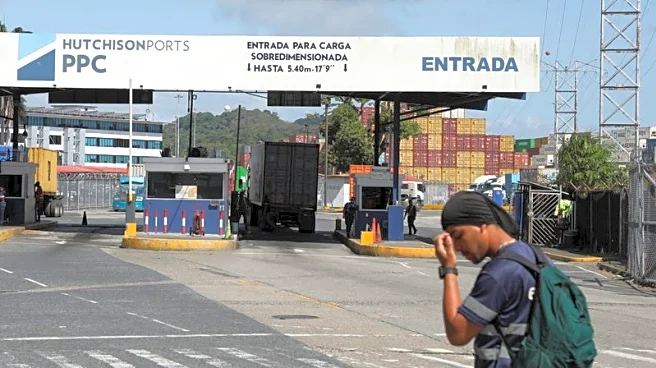
The Danish shipping company Maersk has been appointed as the temporary operator of two key ports on the Panama Canal, following the annulment of a contract held by Hong Kong's CK Hutchison. This decision was made by Panama's Supreme Court, which invalidated
Hutchison's contract, citing it as unconstitutional. The move comes after President Trump expressed concerns over Chinese control of the canal, which is a critical trade route handling 40% of U.S. container traffic. The Panama Maritime Authority announced that APM Terminals, a subsidiary of Maersk, will manage the Balboa and Cristobal ports. The annulment of Hutchison's contract was requested by Panama's comptroller, who argued that the company failed to pay $1.2 billion owed to the state. The U.S. has welcomed this decision, while China has vowed to protect its companies' interests.
Why It's Important?
This development is significant as it highlights the geopolitical tensions between the U.S. and China over strategic infrastructure. The Panama Canal is a vital trade artery, and control over its operations has implications for global trade dynamics. The U.S. sees this as a move to curb Chinese influence in the region, aligning with its broader strategy to counter China's global economic reach. For Panama, this decision could lead to a reevaluation of foreign investments and partnerships, potentially affecting its economic stability. The involvement of Maersk, a major player in global shipping, ensures continuity of operations, but also signals a shift in the balance of power in the region's trade infrastructure.
What's Next?
Panama is expected to initiate a transition period leading to a new concession for the canal ports, with terms favorable to the country. This process will likely involve negotiations with potential operators, balancing national interests with international pressures. The U.S. may continue to exert influence to ensure that future operations align with its strategic interests. Meanwhile, China is expected to respond diplomatically and economically to protect its investments and maintain its presence in Latin America. The outcome of these developments could reshape trade routes and alliances in the region.
Beyond the Headlines
The annulment of Hutchison's contract and the subsequent appointment of Maersk could have long-term implications for international trade policies and alliances. It underscores the growing trend of countries reassessing their trade relationships in response to geopolitical shifts. This situation also raises questions about the legal and ethical dimensions of foreign investments in strategic infrastructure, particularly in regions with significant U.S. influence. The decision may prompt other countries to reconsider their own infrastructure partnerships, potentially leading to a more fragmented global trade landscape.