






What's Happening?
U.S. Representative Jake Ellzey, alongside Assistant Secretary of the Navy for Manpower and Reserve Affairs Benjamin C. Kohlmann and Deputy Assistant Secretary of the Navy Chris Grisafe, visited the University of Texas at Arlington (UTA). The delegation
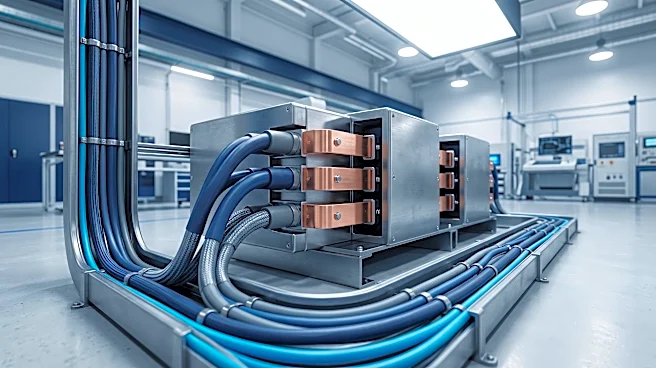
toured UTA’s Power and Energy Innovative Research (PEIR) Laboratory, which is central to an $86 million U.S. Navy contract. This contract supports the development and testing of advanced electrical power technologies for the Navy’s next generation of ships. The PEIR Laboratory evaluates how naval vessels generate, store, distribute, and cool electrical power, including systems for large unmanned vessels designed for extended autonomous operations. David Wetz, professor of electrical engineering and director of UTA’s Pulsed Power and Energy Laboratory, led the demonstration, highlighting the university's role in military power systems development and its nearly $125 million in Department of Defense funding for pulsed power research.
Why It's Important?
The research conducted at UTA’s PEIR Laboratory is crucial for enhancing the reliability and capability of future U.S. naval fleets. By rigorously testing electrical systems before deployment, the laboratory helps the Navy identify technical challenges, evaluate equipment performance, and mitigate risks associated with acquiring advanced shipboard power systems. This directly impacts national security by ensuring that naval vessels are equipped with robust and dependable power infrastructure, which is vital for operational effectiveness in critical missions. The collaboration also fosters workforce development and industry partnerships, strengthening the defense industrial base and creating opportunities for commercializing emerging technologies. For Texas, it solidifies UTA's position as a key research hub, attracting significant federal funding and contributing to technological innovation within the state.
What's Next?
UTA plans to expand its research infrastructure, including the construction of an additional testing annex, to further support its defense partnerships and advanced power systems research. This expansion will enable the university to continue its work on batteries, capacitors, and other energy storage technologies under demanding electrical conditions. The ongoing collaboration between UTA, the U.S. Navy, and defense industry leaders is expected to yield further advancements in shipboard power systems, potentially leading to more efficient, powerful, and resilient naval vessels. These developments will likely influence future naval procurement strategies and technological integration across the fleet, ensuring the U.S. Navy maintains a technological edge.
Beyond the Headlines
The partnership between academic institutions like UTA and the Department of Defense signifies a broader trend of leveraging university research capabilities to address complex national security challenges. This model not only accelerates technological innovation but also cultivates a skilled workforce pipeline, as students gain hands-on experience with cutting-edge defense projects. The focus on advanced electrical power systems reflects a strategic shift in naval warfare, where energy capacity directly translates to operational flexibility and the ability to deploy advanced weapon systems. This collaboration also underscores the economic impact of defense contracts, providing substantial funding for research and development, creating jobs, and fostering regional economic growth through technological leadership.