


What's Happening?
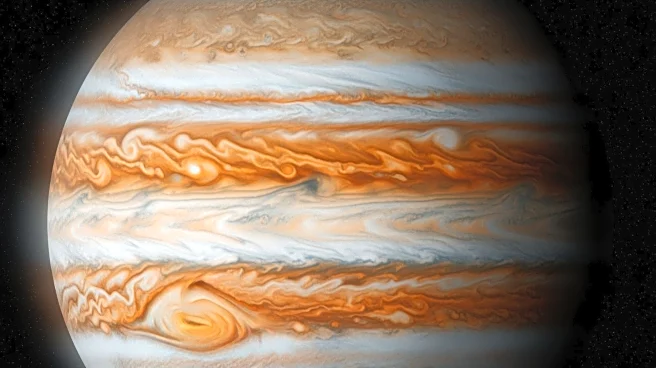
A study led by researchers at the University of Chicago and the Jet Propulsion Laboratory has developed the most detailed model of Jupiter's atmosphere to date. This model provides new insights into the planet's composition, suggesting that Jupiter contains
about one and a half times more oxygen than the sun. The research, published in The Planetary Science Journal, helps resolve long-standing debates about Jupiter's makeup and offers a deeper understanding of the planet's formation and the solar system's history. The study combines atmospheric chemistry with hydrodynamics to simulate the complex interactions within Jupiter's atmosphere, revealing slower atmospheric circulation than previously thought.
Why It's Important?
Understanding Jupiter's composition is crucial for planetary science, as it offers clues about the formation of the solar system and the processes that govern planetary development. The new model's findings on oxygen content challenge previous assumptions and provide a more accurate picture of Jupiter's origins. This research not only enhances our knowledge of Jupiter but also aids in predicting the formation and potential habitability of exoplanets. By refining our understanding of planetary atmospheres, scientists can better assess which distant worlds might support life.
What's Next?
The study opens new avenues for research into Jupiter's atmospheric dynamics and composition. Future investigations may focus on refining the model further and applying it to other gas giants in the solar system. Additionally, the findings could influence the design of future space missions aimed at exploring Jupiter and its moons. As scientists continue to study Jupiter's atmosphere, they may uncover more about the planet's history and its role in the broader context of planetary science.