






What's Happening?
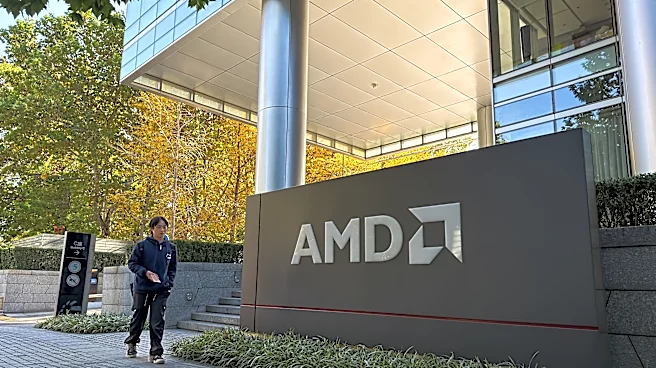
AMD has emphasized the significant role of its El Capitan supercomputer in supporting national security missions through AI-assisted simulation. The company detailed how El Capitan, alongside other advanced systems like Frontier, LUMI, and Lux, is operational
and contributing to critical scientific and national security objectives. AMD's focus is on providing comprehensive computing solutions that integrate tailored hardware, software, and ecosystem support to address complex challenges. The El Capitan supercomputer is specifically noted for its application in AI-assisted simulations, which are crucial for national security. This development is part of AMD's broader strategy to advance exascale computing and AI for science, utilizing its Instinct MI430X GPUs and ROCm platform to deliver high-performance computing capabilities. The company asserts that these supercomputers are designed to handle diverse computing models required for fields such as climate science, drug discovery, advanced manufacturing, and quantum research, ensuring that the right computational power is applied to specific workloads at the optimal time.
Why It's Important?
The deployment and operational status of the El Capitan supercomputer are critical for U.S. national security and technological leadership. Its capability for AI-assisted simulation provides advanced tools for defense and intelligence agencies, enabling more sophisticated analysis, threat assessment, and strategic planning. This directly impacts the nation's ability to maintain a technological edge in a rapidly evolving global landscape. Furthermore, El Capitan's role underscores the increasing convergence of high-performance computing and artificial intelligence in addressing complex, real-world problems. For the U.S. technology sector, it highlights AMD's competitive position in the supercomputing market, challenging other industry players and fostering innovation in GPU and software development. The success of such systems can also attract further investment in domestic research and development, strengthening the U.S. as a hub for advanced computing and AI, which has long-term implications for economic growth and scientific discovery.
What's Next?
Looking ahead, AMD is continuing to develop and deploy its next generation of GPUs, such as the Instinct MI430X, which are designed for the convergence of high-precision compute and AI for science. These advancements will likely enhance the capabilities of supercomputers like El Capitan, allowing for even more complex and rapid AI-assisted simulations. The company is also focusing on expanding its ROCm platform to provide developers with open software for optimizing HPC and AI applications, ensuring long-term stability for production deployments. Future developments will likely involve further integration of AI coding assistants, like AMD HPC Assistant, to streamline the development process for high-performance computing. The ongoing evolution of these technologies suggests a continuous push towards more powerful and versatile supercomputing infrastructure, which will be critical for maintaining national security advantages and driving scientific breakthroughs in various fields.
Beyond the Headlines
The operational success of supercomputers like El Capitan extends beyond immediate national security applications, signaling a broader shift in how complex problems are approached across various sectors. The reliance on AI-assisted simulation in national security highlights an increasing dependence on advanced computational models to inform critical decisions, potentially reducing human error and accelerating response times in crisis situations. This also raises ethical considerations regarding the autonomy of AI in sensitive defense applications and the need for robust oversight. Furthermore, the development of such powerful computing infrastructure could lead to a 'trickle-down' effect, where technologies and methodologies developed for supercomputers eventually find applications in commercial sectors, driving innovation in areas like drug discovery, materials science, and climate modeling. The emphasis on open software platforms like ROCm also suggests a move towards greater collaboration and accessibility in high-performance computing, potentially democratizing access to advanced computational tools for a wider range of researchers and institutions.