
What's Happening?
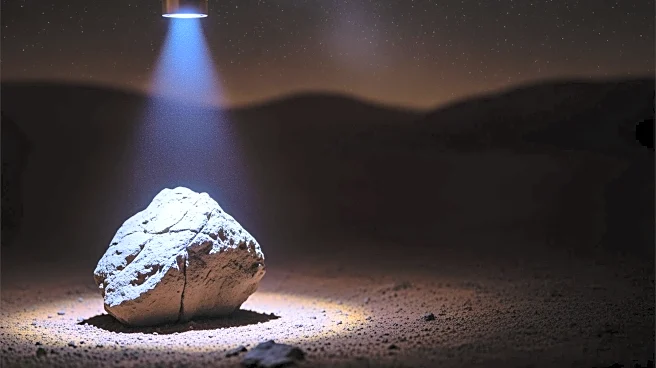
NASA's Curiosity Mars rover has successfully captured a rare nighttime image of the Martian surface using its onboard LED lights. This photograph, taken on December 6, 2025, marks the 4,740th Martian day
of Curiosity's mission. The rover's LEDs, part of the Mars Hand Lens Imager (MAHLI), are typically used to illuminate shaded areas during daytime operations. However, for this particular image, the Mast Camera (Mastcam) was employed to capture the scene. The use of white-light LEDs helps eliminate the environmental effects of Mars' dusty, reddish sunlight, allowing for more accurate color reproduction. This capability is crucial for analyzing the composition of Martian rocks, especially after drilling operations. The recent photo was taken after drilling a rock target named 'Nevado Sajama,' where the team found the drill hole walls smooth enough for a detailed nighttime photoshoot.
Why It's Important?
The ability to capture accurate color images of Mars' surface at night is a significant advancement for scientific research. By using white-light LEDs, NASA can mitigate the color distortion caused by the planet's reddish sunlight, providing clearer insights into the geological composition of Martian rocks. This technological capability enhances the rover's ability to conduct detailed analyses, which is essential for understanding Mars' history and potential for past life. The improved imaging techniques could lead to more precise data collection, aiding future missions and potentially informing the search for life on Mars. The success of this nighttime imaging also demonstrates the versatility and longevity of the Curiosity rover, which continues to provide valuable scientific data years into its mission.
What's Next?
Following this successful nighttime imaging, NASA may continue to utilize the LED technology for further nighttime observations, potentially expanding the scope of Curiosity's scientific investigations. The ability to capture high-quality images in low-light conditions could open new avenues for research, particularly in areas that are difficult to analyze during the day due to harsh lighting conditions. Future missions to Mars might incorporate similar or enhanced technologies, building on the lessons learned from Curiosity's operations. Additionally, the data collected from these nighttime images could inform the planning and execution of upcoming Mars missions, including those aimed at sample return or human exploration.