


What's Happening?
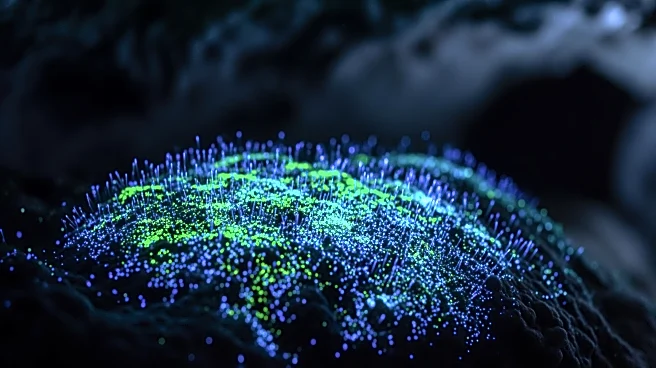
Researchers have discovered cyanobacteria in New Mexico's Carlsbad Caverns that photosynthesize using near-infrared light, a type of light invisible to the human eye. This finding, led by Hazel Barton and Lars Behrendt, suggests that life can thrive in environments
with minimal visible light. The limestone cave walls reflect near-infrared light, creating conditions where these microbes can survive. This discovery could influence the search for life on other planets, particularly those orbiting red dwarf stars, which emit mostly near-infrared light.
Why It's Important?
The ability of these microbes to photosynthesize in low-light conditions expands the potential for life in extraterrestrial environments. This discovery could reshape astrobiological research, as it suggests that planets with low visible light but abundant near-infrared light could support life. The implications for the search for habitable planets are significant, potentially guiding future missions and research using tools like the James Webb Space Telescope. This finding underscores the adaptability of life and broadens the criteria for identifying life-supporting planets.