



What's Happening?
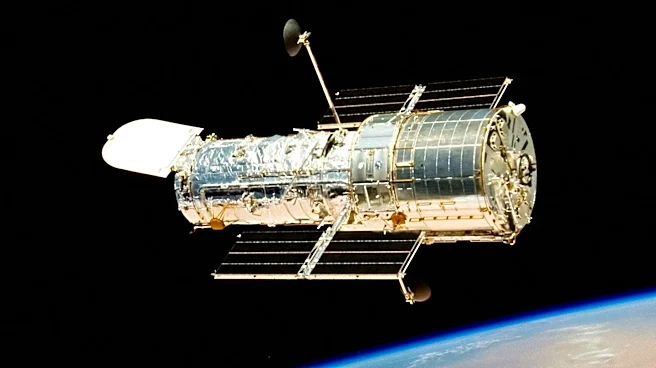
The Hubble Space Telescope is gradually losing altitude and is projected to re-enter Earth's atmosphere as early as 2032, with a 50% probability by December 2033, according to NASA estimates. Researchers are advocating for its rescue, emphasizing its continued
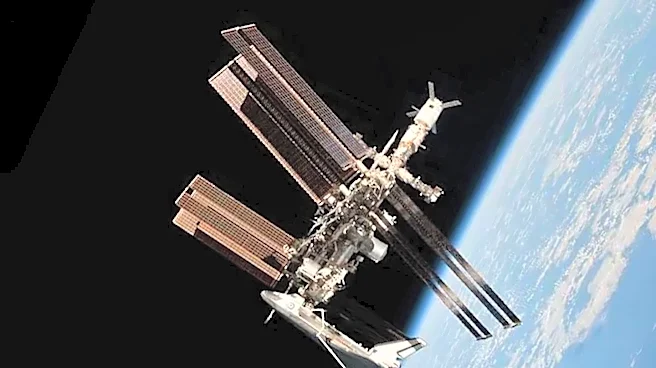
scientific value and the potential for a significant capability gap if it is lost. The telescope, launched in 1990, has been a source of over 23,000 peer-reviewed scientific papers. Its orbit requires periodic boosting due to atmospheric drag, a task previously performed by the Space Shuttle fleet, which has since been retired. NASA has issued a call for proposals from the commercial sector, inviting companies to submit plans by November 30 for either raising Hubble's orbit to at least 600 kilometers or safely de-orbiting it into the ocean. This initiative follows a similar call in 2022, which did not result in a mission.
Why It's Important?
The potential loss of the Hubble Space Telescope represents a significant setback for astronomical research, particularly in high-resolution ultraviolet imaging, where it currently outperforms all other available instruments. While future missions like the Ultraviolet Explorer (2030) and the Habitable Worlds Observatory (2040s) are planned, their capabilities may not fully match Hubble's, potentially creating a decade or more of lost scientific opportunity. Preserving Hubble could also maintain critical space exploration skills, as noted by Stephen Wilkins of the University of Sussex. The decision to invest in a rescue mission involves complex cost-benefit analyses, balancing the telescope's ongoing scientific output against the resources required for its maintenance and a potential boost. The commercial sector's involvement highlights a growing trend in space operations, where private companies are increasingly tasked with missions previously handled by government agencies.
What's Next?
NASA is actively soliciting proposals from commercial entities until November 30 for solutions to either raise Hubble's orbit or safely de-orbit it. The agency is open to a wide range of technological approaches and is not limiting potential responses. A panel of scientists, including Thomas Haworth from Queen Mary University of London, is advising NASA, with a strong recommendation for a re-boost mission. NASA administrators will need to make a timely decision, as planning and executing such a mission will require several years. The success of a commercial mission, similar to a failed attempt earlier this year to boost the Neil Gehrels Swift Observatory, would demonstrate the viability of private sector involvement in complex space operations. The outcome will determine the future of one of the most iconic and scientifically productive space telescopes.
Beyond the Headlines
The situation with the Hubble Space Telescope underscores the broader challenges of maintaining aging space infrastructure and the evolving role of commercial space companies. The debate over whether to save Hubble highlights the tension between preserving legacy assets and investing in new technologies. While Hubble has grapple points designed for servicing, the absence of a dedicated shuttle fleet necessitates innovative commercial solutions. The decision also carries ethical implications regarding the allocation of scientific funding, as resources directed towards Hubble's preservation might otherwise support new projects. The potential for parts of the telescope to survive atmospheric re-entry also raises concerns about uncontrolled debris, emphasizing the need for a controlled de-orbiting if a re-boost is not feasible. This scenario could set precedents for how future large-scale scientific instruments in space are managed at the end of their operational lives.