



What's Happening?
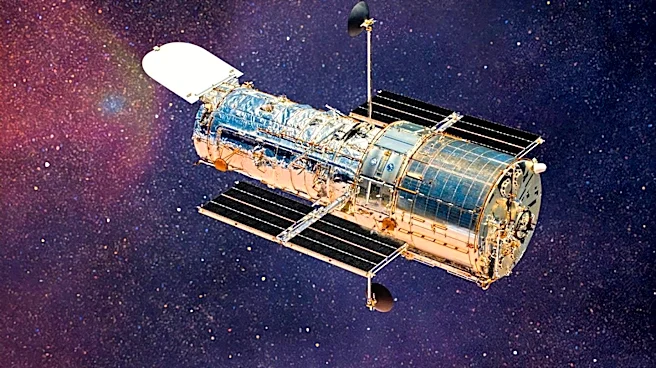
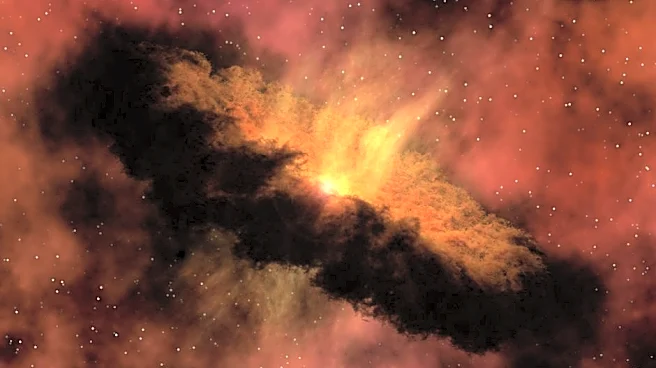
The Hubble Space Telescope has captured unprecedented details of a mysterious structure known as the 'Cat's Tail' within the Beta Pictoris debris disk, located 63 light-years from Earth. This feature, previously observed only in infrared by the James
Webb Space Telescope, has now been seen in visible light for the first time. Led by University of Arizona planetary scientist Arin Avsar, the research team published their findings in The Astrophysical Journal Letters. The 'Cat's Tail' is believed to be the result of a collision between large celestial bodies, possibly Pluto-sized objects. The new observations indicate that the structure is composed of porous, micron-sized, carbon-rich dust, which absorbs visible light, explaining its previous invisibility at shorter wavelengths. The study also suggests that the 'Cat's Tail' may extend sideways relative to Earth, rather than directly behind the star, and is largely in the same plane as the star. Additionally, Hubble identified a warp in the dust halo surrounding Beta Pictoris, likely caused by the gravitational influence of the gas giant Beta Pic b, one of the system's three planets.
Why It's Important?
This discovery significantly advances our understanding of planet formation and the chaotic early stages of solar systems. By observing the 'Cat's Tail' in visible light, astronomers gain crucial insights into the composition and structure of debris disks, which are remnants of planetary formation. The finding that the dust grains are highly porous and carbon-based challenges existing models of how such materials form after high-velocity collisions. This research provides a valuable analog for studying the early history of our own solar system, offering clues about the processes that shaped the Kuiper Belt and the influence of giant planets on smaller celestial bodies. Understanding these dynamics helps scientists piece together the violent and complex evolution of planetary systems, shedding light on how planets like Earth came to be. The detection of the dust halo warp further emphasizes the profound gravitational impact of giant planets on their surrounding environments, extending hundreds of astronomical units.
What's Next?
Future research will likely focus on further analyzing the composition and porosity of the dust grains in the 'Cat's Tail' to understand the conditions under which they formed. Scientists may conduct more detailed simulations of high-velocity collisions to determine how such porous, carbon-rich material could be created. Continued observations with both the Hubble Space Telescope and the James Webb Space Telescope, combining their visible and infrared capabilities, will be crucial for refining the three-dimensional structure of the 'Cat's Tail' and the Beta Pictoris disk. Further investigation into the warp in the dust halo could provide more evidence of the gravitational interactions between giant planets and their debris disks, potentially leading to a better understanding of how giant planets clear out smaller bodies in young solar systems. These ongoing studies will contribute to a more comprehensive model of planetary system evolution.
Beyond the Headlines
The study of the 'Cat's Tail' in the Beta Pictoris system offers a unique window into the fundamental processes of cosmic evolution. The presence of highly porous, carbon-rich dust suggests extreme conditions during the collision event, possibly involving vaporization and recondensation of carbon grains. This could imply that the early universe's building blocks were more complex and dynamic than previously imagined. The ability of the Hubble Space Telescope to reveal these details in visible light, complementing infrared observations, underscores the importance of multi-wavelength astronomy in unraveling cosmic mysteries. This research not only deepens our knowledge of exoplanetary systems but also prompts broader questions about the prevalence of such violent formation events and their role in shaping the diversity of planetary systems observed across the galaxy. It highlights the continuous refinement of our understanding of the universe through persistent observation and technological advancement.