

What's Happening?
A study by researchers from EPFL, the Free University of Berlin, and the University of Copenhagen reveals that noise significantly limits the effective depth and power of quantum circuits. Quantum circuits, composed of multiple quantum operations, are
crucial for quantum computing. However, noise, which affects every gate operation and qubit, curtails the useful length of these circuits. The study shows that beyond a certain point, earlier operations in a noisy circuit lose influence, leaving only the final steps as meaningful contributors to the output. This noise-induced attenuation imposes a ceiling on the maximum depth of quantum circuits under realistic noise levels.
Why It's Important?
The findings highlight a fundamental barrier in the development of quantum computing, emphasizing the need for noise mitigation strategies. For near-term quantum computers, which are inherently noisy, simply adding more gates to increase complexity is unlikely to yield superior results. Instead, progress must come from reducing noise or developing architectures and algorithms that can circumvent or exploit noise's structured properties. This research provides a clearer understanding of the limitations imposed by noise, guiding future efforts to enhance quantum computing capabilities.
What's Next?
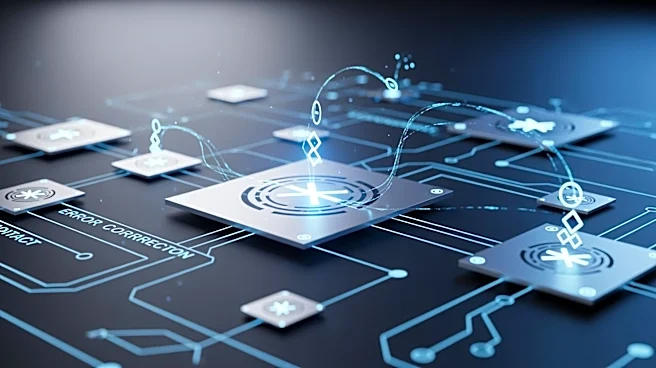
The study suggests that future advancements in quantum computing will depend heavily on improving noise control or leveraging noise-aware algorithms. Researchers will need to focus on developing error correction techniques, noise tailoring, and novel hardware designs to push beyond the current limitations. This nuanced understanding of noise's impact on circuit depth will inform the design of more robust quantum systems, ultimately paving the way for practical quantum advantage.