
What's Happening?
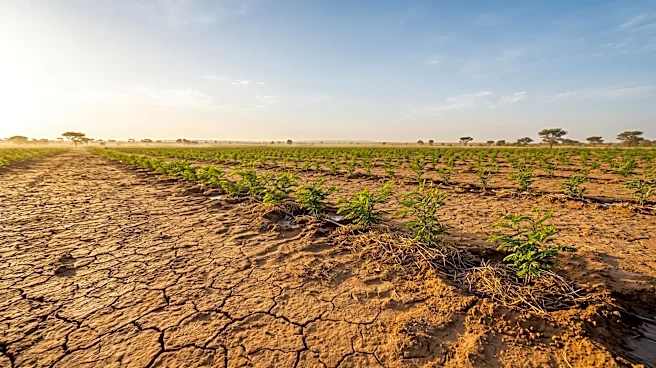
A new $78 million program has been launched to restore 270,000 hectares of degraded land and improve the livelihoods of five million people across nine countries of the Great Green Wall. This initiative, supported by funding from the Global Environment
Facility (GEF) and implementation assistance from the UN Environment Programme (UNEP), aims to regenerate one of the world's most climate-vulnerable regions. The participating countries span from the Sahel to the Horn of Africa and include Burkina Faso, Chad, Ethiopia, The Gambia, Mali, Mauritania, Niger, Nigeria, and Senegal. UNEP will oversee eight of the ten projects, with the West African Development Bank (BOAD) implementing the remaining two. The program, named 'Transformation Approach to Large Scale Investment in Support of the Implementation of the Great Green Wall Initiative,' addresses interconnected challenges such as environmental stress, food insecurity, and conflict, which have displaced over 4 million people in the region.
Why It's Important?
This initiative is critically important for addressing the severe environmental degradation and humanitarian crises in the Sahel region, which is warming at 1.5 times the global average. With two-thirds of productive land degraded, the program directly tackles issues of food systems, water resources, and livelihoods, which are under immense pressure. By restoring land and strengthening ecosystems, it aims to provide sustainable alternatives for millions of young people who might otherwise consider migrating from poverty-stricken areas. The coordinated regional approach, involving nine national governments and international organizations, signifies a robust commitment to climate resilience and sustainable development. Improved livelihoods and environmental stability can reduce forced displacement and enhance regional security, contributing to broader stability in a geopolitically sensitive area. The program's focus on agriculture, pastoralism, and rural livelihoods directly benefits vulnerable communities.
What's Next?
The program will proceed with specific restoration efforts across the nine participating countries. For instance, Mali will see 150,000 hectares regenerated, and Niger will rehabilitate 55,000 hectares of farmland, woodland, and grazing land. The Gambia will focus on wetland and forest corridor restoration, benefiting nearly 800,000 people, predominantly women. Women-led enterprises are central to projects in Nigeria's Kebbi State and Mauritania, while Chad and Burkina Faso will concentrate on drought-resilient land management. Ethiopia plans to restore 22,000 hectares of degraded land and improve the management of 40,000 hectares of natural forest. The initiative will also emphasize alignment, improved monitoring, and enhanced knowledge exchange among participating countries. The $78 million GEF grant is complemented by over $500 million in co-financing from other international partners, ensuring sustained efforts towards achieving the goal of restoring 30% of degraded land by 2030.
Beyond the Headlines
Beyond the immediate environmental and economic impacts, this Great Green Wall initiative carries significant geopolitical and social implications. By fostering economic stability and reducing resource scarcity, it can act as a powerful deterrent to conflict and forced migration, which are major drivers of instability in the region. The program's emphasis on women-led enterprises and community-based solutions highlights a progressive approach to development, recognizing the crucial role of local populations in achieving sustainable outcomes. This large-scale environmental restoration effort could also serve as a model for other climate-vulnerable regions globally, demonstrating the potential for international cooperation to address complex environmental and humanitarian challenges. The long-term success of the Great Green Wall could redefine the narrative of the Sahel, transforming it from a region of crisis into one of resilience and opportunity, thereby influencing global perceptions and policy approaches to climate change and development.