
What's Happening?
Researchers from the University of Utah and the Colorado School of Mines have conducted a study examining how rainfall patterns responded to extreme global warming during the Paleogene Period, which began
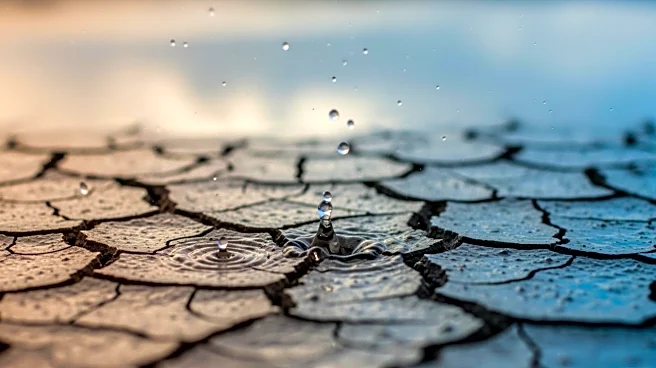
66 million years ago. This period was characterized by atmospheric carbon dioxide levels two to four times higher than today. The study utilized geological proxies such as plant fossils, soil chemistry, and river deposits to reconstruct historical rainfall patterns. Contrary to the common belief that wet regions become wetter and dry regions drier with warming, the study found that mid-latitude regions became drier, while polar regions experienced more monsoonal conditions. The research highlights that rainfall during this period was highly irregular, with intense downpours followed by prolonged dry spells.
Why It's Important?
The findings of this study challenge existing climate models that predict more uniform changes in precipitation patterns with global warming. By revealing that rainfall can become more variable and less predictable, the study suggests that current models may underestimate the complexity of future climate scenarios. This has significant implications for water management, agriculture, and ecosystem sustainability, as irregular rainfall can lead to challenges in planning for floods and droughts. Understanding these patterns is crucial for preparing for potential future climate conditions that could mirror those of the Paleogene Period.
What's Next?
The study's results indicate a need for climate models to incorporate more complex variables to accurately predict future rainfall patterns. Researchers may focus on refining these models to better account for the variability observed in historical data. Additionally, policymakers and environmental planners might need to consider these findings when developing strategies for water resource management and agricultural planning in anticipation of more erratic weather patterns.
Beyond the Headlines
The study underscores the importance of paleoclimate research in understanding future climate dynamics. By examining past climate conditions, scientists can gain insights into potential thresholds and tipping points in Earth's climate system. This research also highlights the role of interdisciplinary collaboration, combining geological data with climate modeling to provide a more comprehensive understanding of historical climate events.