



What's Happening?
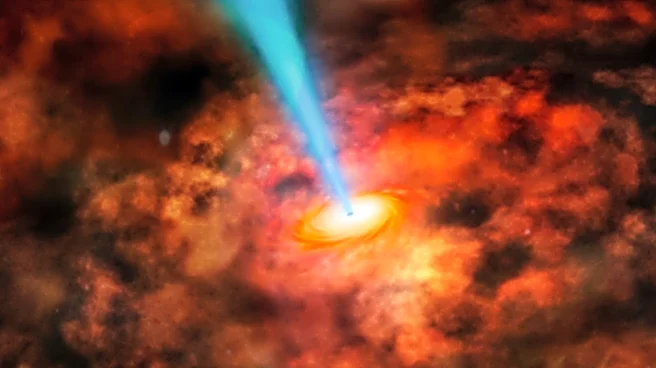
A new study led by Caltech researchers, utilizing data from the LIGO–Virgo–KAGRA gravitational-wave observatory network, indicates that a significant population of black holes may have originated from stars that failed to explode as supernovae. The study analyzed
the mass distribution of 257 black hole mergers detected over the past decade, revealing a prominent peak at 10 solar masses, accounting for three-quarters of the sample. Crucially, a distinct absence of black holes in the 12- to 16-solar-mass range was observed. This finding aligns with theoretical predictions for black holes formed through the quiet implosion of massive stars, rather than the more common supernova explosions. The research, published in Physical Review D, also examined the spin rates of these black holes, finding that the 10-solar-mass black holes exhibit a narrower range of spin rates, further supporting the idea of a common origin distinct from the general black hole population.
Why It's Important?
This research is significant as it provides observational evidence supporting a theoretical model for black hole formation, specifically the 'failed supernova' hypothesis. Understanding the origins of black holes is fundamental to astrophysics, impacting our comprehension of stellar evolution, the life cycles of massive stars, and the distribution of matter in the universe. The identification of a distinct subpopulation of 10-solar-mass black holes suggests that the processes governing stellar collapse are more varied and complex than previously understood. This could lead to a refinement of current astrophysical models and a deeper insight into the extreme environments where black holes are born. The study's findings also highlight the power of gravitational-wave astronomy in uncovering previously unobservable phenomena, pushing the boundaries of our knowledge about cosmic events.
What's Next?
While the study provides compelling hints, direct evidence for failed supernovae remains elusive. Future research will focus on gathering more data from gravitational-wave observations to further solidify these findings. Isaac Legred, a postdoc at the University of Illinois Urbana-Champaign and lead author, emphasized that more research is needed to confirm the connection between gravitational-wave data and the underlying astrophysics of failed supernovae. Astronomers will continue to refine their models of stellar collapse and black hole formation, potentially leading to new predictions that can be tested with advanced observatories. The ongoing operation and upgrades of gravitational-wave detectors like LIGO, Virgo, and KAGRA will be crucial in collecting the additional data required to confirm or refute this hypothesis, ultimately advancing our understanding of the universe's most enigmatic objects.
Beyond the Headlines
The concept of 'failed supernovae' challenges the traditional understanding of how massive stars end their lives, suggesting a more diverse range of outcomes than previously assumed. This has broader implications for nucleosynthesis, the process by which elements are created within stars, as the quiet implosion of a star would distribute different elements into space compared to a violent supernova. Furthermore, the study touches upon the fundamental physics governing extreme gravitational environments, potentially offering insights into the nature of space-time itself. The collaboration between gravitational-wave observatories across continents underscores the global effort in scientific discovery, pushing the boundaries of human knowledge through advanced technology and interdisciplinary research. The ability to infer such detailed information about black hole origins from gravitational waves alone represents a profound leap in observational astronomy.