






What's Happening?
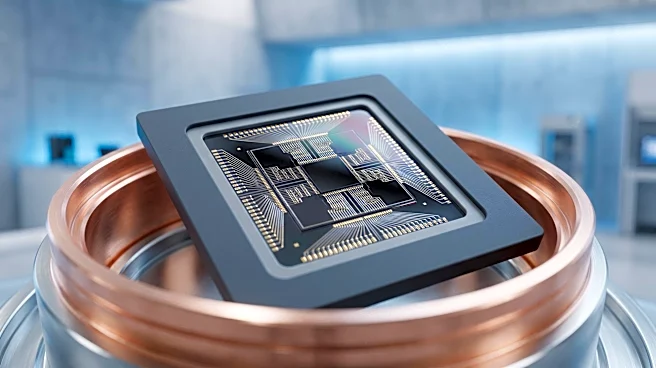
IonQ has announced that it will be the first company to deploy an on-premise quantum computing unit (QPU) at the NVIDIA Accelerated Quantum Research Center (NVAQC). This initiative aims to address the challenges of scaling quantum processors into a new
class of accelerated quantum supercomputers. IonQ's Superion 256 system will be directly linked with an NVIDIA GB200 NVL72 system using NVIDIA NVQLink, with workloads managed by the open NVIDIA CUDA-Q platform. The collaboration will focus on hybrid software development and large-scale system prototyping, with the goal of generating open results and guidance for future AI applications and quantum-GPU co-design. Joint research will target quantum algorithms for portfolio optimization, risk modeling in financial services, materials science, and computational chemistry for drug discovery.
Why It's Important?
This partnership between IonQ and NVIDIA is a significant development for the U.S. technology sector, particularly in the realm of quantum computing and artificial intelligence. By integrating IonQ's quantum systems directly with NVIDIA's AI infrastructure, the NVAQC aims to accelerate breakthroughs needed to transform qubits into useful, large-scale quantum supercomputers. This integration is crucial for tackling complex problems that are currently beyond the capabilities of classical computing. The focus on financial services, materials science, and drug discovery highlights the potential for substantial economic impact, offering new tools for innovation and competitive advantage. This collaboration could set a precedent for how quantum and classical computing resources are combined, influencing future research and development strategies across various industries.
What's Next?
The installation of IonQ's Superion 256 system at the NVAQC is scheduled for next year, with the first customer deliveries of the Superion 256 expected in 2027. The joint research program will immediately commence, focusing on hybrid software development and large-scale system prototyping. This will involve generating open results and developing a guide for future AI use cases and quantum-GPU co-design. The companies have already published joint research with Oak Ridge National Laboratory and the University of Tennessee, demonstrating a framework combining generative AI with distributed quantum algorithms. This ongoing research and development will continue to push the boundaries of quantum-classical computing, with a roadmap to 10,000 qubits and full fault tolerance for IonQ's Superion systems.
Beyond the Headlines
The integration of quantum processing units with AI infrastructure, as exemplified by the IonQ-NVIDIA partnership, signals a deeper convergence of advanced computing paradigms. This development could lead to a new era of 'accelerated quantum supercomputers,' fundamentally changing how complex problems are approached in scientific research and industrial applications. The emphasis on open models and open-source software within this collaboration suggests a commitment to fostering a broader ecosystem for quantum development, potentially democratizing access to these powerful tools. However, it also raises questions about intellectual property and the competitive landscape as these technologies mature. The long-term implications include the potential for significant disruptions in industries reliant on computational power, as well as the need for a skilled workforce capable of navigating this new hybrid computing environment.