
What's Happening?
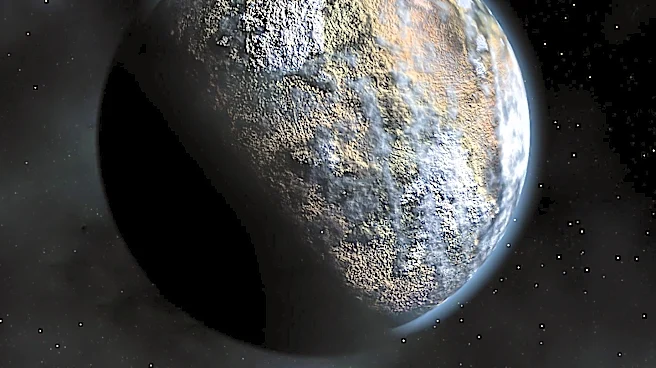
Astronomers have discovered a potentially habitable rocky planet, GJ 3378b, located 25 light-years away in the habitable zone of a red dwarf star. Initially discovered in 2024, recent observations have revised
its mass to 2.3 times that of Earth, classifying it as a rocky super-Earth. The planet's orbital period is 21 days, placing it closer to its star than previously thought, which could allow for liquid water if an atmosphere exists. However, the red dwarf's radiation poses a threat to any potential atmosphere. The planet was detected through the gravitational effects on its star, rather than direct observation.
Why It's Important?
The discovery of GJ 3378b is significant as it adds to the list of nearby exoplanets that could potentially support life. Its proximity to Earth makes it a prime candidate for future studies on habitability and atmospheric composition. The planet's location in the habitable zone raises hopes for finding biosignatures, which could provide insights into the possibility of life beyond Earth. This discovery also highlights the challenges posed by stellar radiation in maintaining atmospheres on planets orbiting red dwarfs, a common type of star in the galaxy.
What's Next?
Future observations, possibly by the James Webb Space Telescope or the upcoming Habitable Worlds Observatory, will aim to determine if GJ 3378b has an atmosphere. These studies will focus on detecting atmospheric components that could indicate habitability. The planet's discovery encourages further exploration of nearby stars for similar planets, potentially leading to breakthroughs in understanding the conditions necessary for life.