


What's Happening?
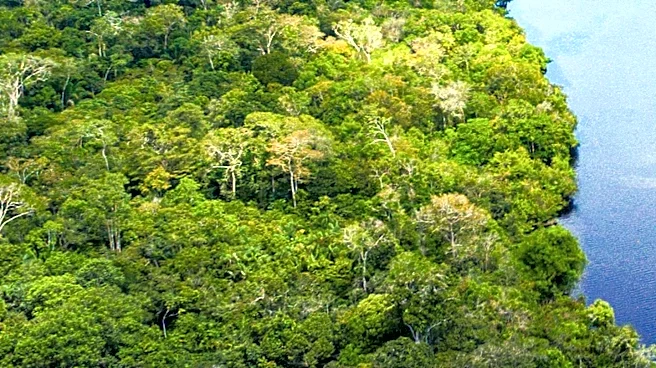
The Amazon rainforest plays a crucial role in generating moisture that forms invisible rivers in the sky, which travel thousands of kilometers to water farmland in Brazil, Bolivia, Peru, and Argentina. This phenomenon, known as 'flying rivers,' is essential
for maintaining the agricultural productivity of these regions. According to Dr. Antonio Nobre, a leading scientific proponent of the flying rivers concept, the Amazon's moisture stream significantly contributes to the annual rainfall in major agricultural regions across the southern half of South America. If the Amazon rainforest ceased to function as a moisture pump, Brazil’s agricultural heartland, which produces about seventy percent of the country’s economic output, would become substantially drier over the next few years. Northern Bolivia and southern Peru would lose more than seventy percent of their annual precipitation, while northern Argentina and Paraguay could face desertification.
Why It's Important?
The Amazon rainforest's ability to function as a moisture pump is vital for the economic stability of several South American countries. The agricultural sectors in Brazil, Bolivia, Peru, and Argentina heavily rely on the rainfall generated by the Amazon's moisture recycling process. Any disruption to this system could lead to severe economic consequences, including reduced agricultural output and increased desertification. This would not only affect local economies but also have broader implications for global food supply chains, as these regions are significant producers of soybeans, cattle feed, coffee, and sugar cane. The potential loss of the Amazon's moisture pump underscores the importance of preserving the rainforest to maintain ecological balance and economic stability in the region.
What's Next?
The ongoing deforestation of the Amazon poses a significant threat to its ability to function as a moisture pump. Current estimates suggest that approximately one million square kilometers of the Amazon have already been converted from forest to agricultural land, which is about a fifth of the total area of the original forest. This deforestation trajectory could push the Amazon past a tipping point where it can no longer sustain its moisture recycling process. If this occurs, the resulting changes in rainfall patterns could lead to prolonged droughts and increased variability in precipitation, further exacerbating the challenges faced by agricultural sectors in South America. Efforts to curb deforestation and promote sustainable land use practices are critical to preserving the Amazon's ecological functions.
Beyond the Headlines
The concept of flying rivers highlights the interconnectedness of ecological systems and the far-reaching impacts of environmental changes. The Amazon's role in atmospheric moisture recycling is a reminder of the complex and often unseen ways in which natural systems support human economies and societies. The potential loss of this system raises ethical questions about the responsibility of nations to protect shared environmental resources and the need for international cooperation in addressing climate change and deforestation. As the Amazon continues to face threats from deforestation and climate change, understanding and preserving its ecological functions becomes increasingly important for the well-being of both local and global communities.