


What's Happening?
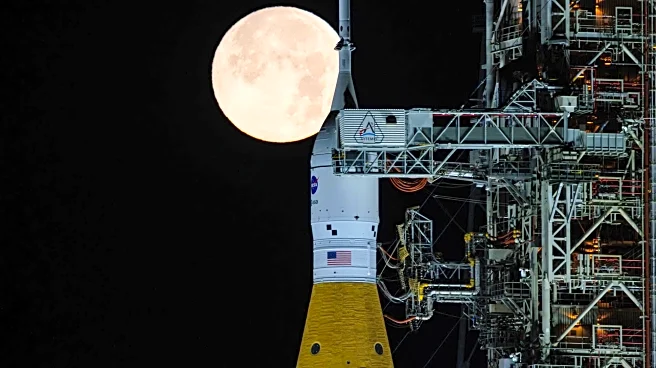
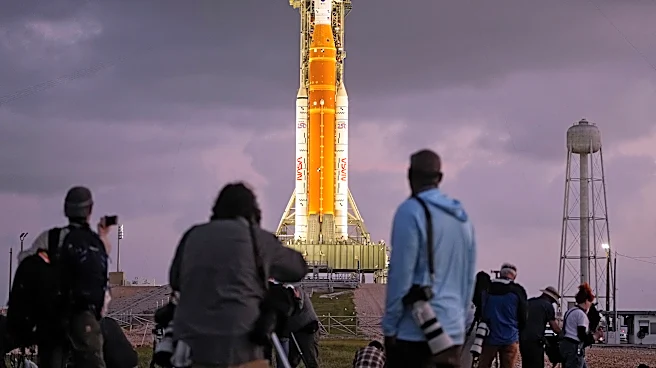
The Artemis II mission is set to launch from Cape Canaveral, Florida, marking a significant milestone in space exploration. The mission will be the first crewed flight of the Orion spacecraft, with a diverse crew including NASA astronauts Reid Wiseman,
Victor Glover, Christina Koch, and Canadian astronaut Jeremy Hansen. The mission aims to test the spacecraft's systems and perform a lunar flyby, setting the stage for future lunar landings. Weather conditions have been closely monitored, with forecasts indicating an 80% chance of favorable conditions for the launch. The mission is part of NASA's broader Artemis program, which seeks to establish a sustainable human presence on the Moon.
Why It's Important?
The Artemis II mission is crucial for advancing human space exploration beyond low Earth orbit. It represents a key step in NASA's Artemis program, which aims to return humans to the Moon and eventually explore Mars. The mission highlights international collaboration, with contributions from the Canadian Space Agency and other global partners. The inclusion of diverse crew members, such as Christina Koch, who will be the first woman to travel into deep space, underscores the mission's commitment to diversity and inclusion. The success of Artemis II will provide valuable data and experience for future missions, including the planned Artemis III lunar landing.
What's Next?
Following the successful launch and completion of the Artemis II mission, NASA will focus on preparing for the Artemis III mission, which aims to land humans on the Moon. The data collected from Artemis II will be used to refine systems and procedures for future lunar missions. The mission also serves as a stepping stone for future exploration of Mars, with NASA aiming to establish a sustainable presence on the Moon as a precursor to Mars missions. International collaboration is expected to continue, with more countries joining the Artemis Accords and contributing to the exploration of space.