
What's Happening?
Armenian Prime Minister Nikol Pashinyan has publicly stated that Armenia is not aligned with Russia regarding the Ukraine conflict. This announcement was made during a government briefing, following Ukrainian
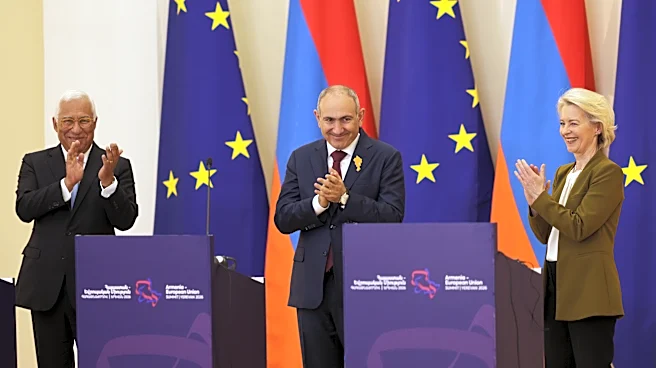
President Volodymyr Zelensky's visit to Yerevan. Pashinyan emphasized that Armenia's foreign policy is driven by its own strategic interests, including its peace process with Azerbaijan. This marks a significant shift in Armenia's foreign relations, as it distances itself from Russia, especially after Moscow's perceived support for Azerbaijan in the Nagorno-Karabakh conflict. Armenia has also ratified the Rome Statute, establishing the International Criminal Court, further indicating its move towards a more independent foreign policy.
Why It's Important?
This development is significant as it highlights a shift in the geopolitical landscape of the region. Armenia's distancing from Russia could alter alliances and influence the balance of power in the Caucasus. It also reflects broader regional dynamics, where countries are reassessing their foreign policies in light of Russia's actions in Ukraine. For the U.S. and European allies, Armenia's stance could open new diplomatic avenues and partnerships. Conversely, it may strain Armenia's relations with Russia, impacting economic and security cooperation within the Collective Security Treaty Organisation (CSTO).
What's Next?
Armenia's decision to distance itself from Russia may lead to further diplomatic engagements with Western countries. The international community will likely monitor how this affects Armenia's role in regional peace efforts, particularly with Azerbaijan. Additionally, Russia's response to Armenia's shift could influence future CSTO dynamics and regional security arrangements.