





What's Happening?
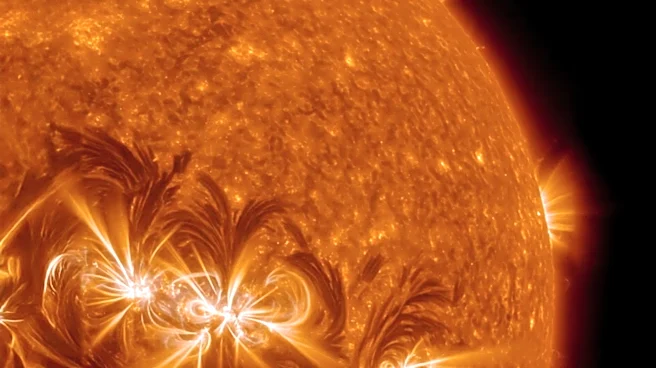
The Met Office has issued a space weather forecast indicating predominantly low solar activity for the coming days. Over the past 24 hours, solar activity remained low, with only common class flares observed. There are currently nine sunspot regions on the Earth-facing
disc, with the largest and most active region near the southwest limb continuing to decay. No Earth-directed Coronal Mass Ejections (CMEs) were observed. Solar wind speeds have been between background and slightly elevated levels, and geomagnetic activity has been quiet. The forecast anticipates mostly low solar activity, with a slight chance of isolated low-level M-class flares. Geomagnetic conditions are expected to remain mainly quiet until Days 3-4 (November 16-17), when fast winds from a coronal hole may connect with Earth, potentially leading to unsettled to active intervals and a slight chance of an isolated G1/Minor geomagnetic storm.
Why It's Important?
While the current forecast indicates generally low solar activity, the potential for even minor geomagnetic storms holds significance for various U.S. sectors. Geomagnetic storms, even at a G1/Minor level, can cause minor impacts on power grids, potentially leading to weak fluctuations. They can also affect satellite operations, causing minor impacts on satellite-based communication and GPS systems, which are crucial for navigation, timing, and various industries across the U.S. Additionally, these storms can cause aurora displays to be visible at higher latitudes, impacting scientific research and potentially disrupting high-frequency radio communications. For industries heavily reliant on precise GPS timing, such as transportation and logistics, or those dependent on satellite communications, even slight disruptions can necessitate operational adjustments. Monitoring these forecasts is essential for preparedness and mitigation strategies across critical infrastructure and technological sectors.
What's Next?
As the Met Office forecast indicates a potential for unsettled to active geomagnetic conditions around November 16-17, stakeholders in the U.S. will continue to monitor space weather advisories closely. Operators of power grids, satellite systems, and communication networks will likely review their protocols for managing potential minor disruptions. This includes ensuring backup systems are ready and that personnel are aware of potential impacts on sensitive equipment. Researchers and space weather agencies will continue to observe solar activity for any unexpected changes or increases in flare intensity or CME events. While no significant impacts are anticipated, the slight chance of a G1/Minor geomagnetic storm means that vigilance will be maintained, and any updates to the forecast will be crucial for those operating critical infrastructure or sensitive technologies.
Beyond the Headlines
The continuous monitoring and forecasting of space weather, even during periods of low activity, underscore the increasing reliance of modern society on space-based technologies. Beyond immediate operational concerns, these forecasts contribute to a broader understanding of the Sun-Earth system and its long-term effects on our technological infrastructure. The subtle interplay between solar winds and Earth's magnetic field, even when resulting in minor events, provides valuable data for improving predictive models and developing more resilient technologies. This ongoing scientific endeavor is crucial for future space exploration, the design of more robust satellites, and the protection of terrestrial power and communication networks from more severe space weather events that could occur during periods of higher solar activity. It highlights a quiet but persistent effort to safeguard our technologically advanced world from extraterrestrial influences.