







What's Happening?
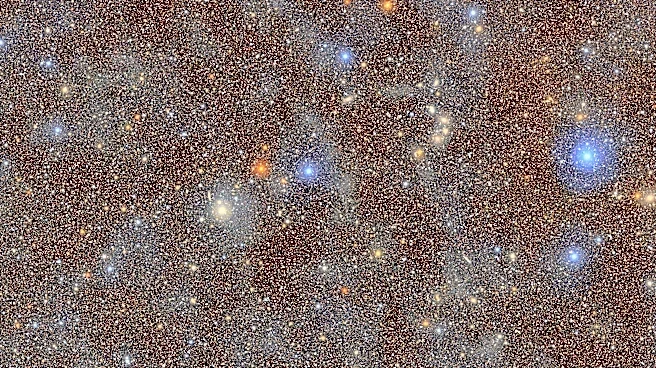
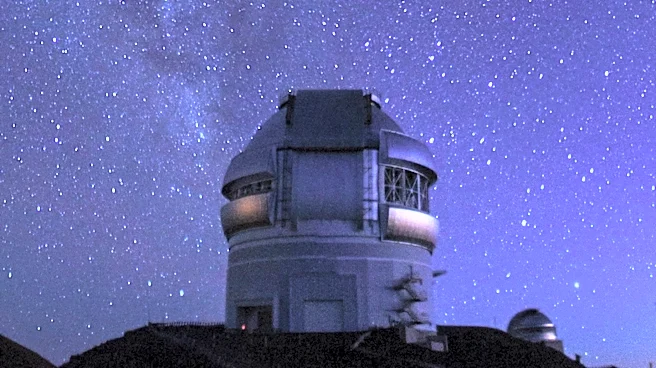
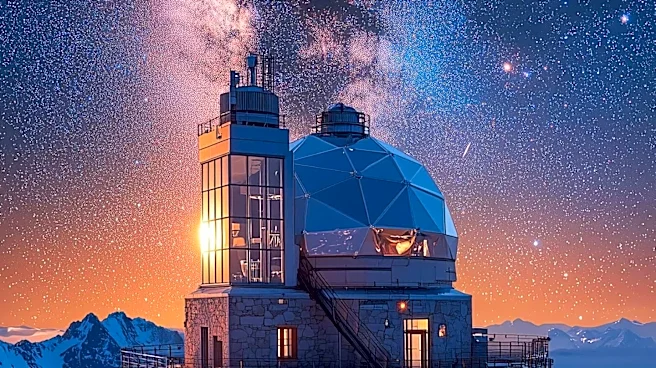
The Vera C. Rubin Observatory has commenced a decade-long survey of the universe using the largest digital camera ever built. Located on a Chilean mountaintop, the observatory will capture detailed images of the southern sky, aiming to map billions of stars
and galaxies. The project, funded by the U.S. National Science Foundation and the Department of Energy, seeks to enhance understanding of cosmic phenomena, including dark matter and dark energy. The observatory's advanced imaging capabilities will allow scientists to study the universe in unprecedented detail, potentially revealing new insights into galaxy formation and the universe's evolution.
Why It's Important?
This survey is crucial for advancing astronomical research and understanding the universe's fundamental components. By mapping stars and galaxies with high precision, scientists can explore the distribution and behavior of dark matter and dark energy, which are critical to understanding the universe's structure and expansion. The data collected will support a wide range of scientific inquiries, potentially leading to breakthroughs in cosmology and astrophysics. The project also exemplifies international collaboration in scientific research, with implications for future space exploration and technology development.
What's Next?
Over the next decade, the observatory will continue to capture and analyze images, contributing to a comprehensive cosmic census. Researchers worldwide will access the data, fostering collaboration and innovation in the field of astronomy. The findings may influence future space missions and inform theoretical models of the universe. As the survey progresses, the scientific community will likely focus on interpreting the data to address longstanding questions about the universe's origins and fate.