

What's Happening?
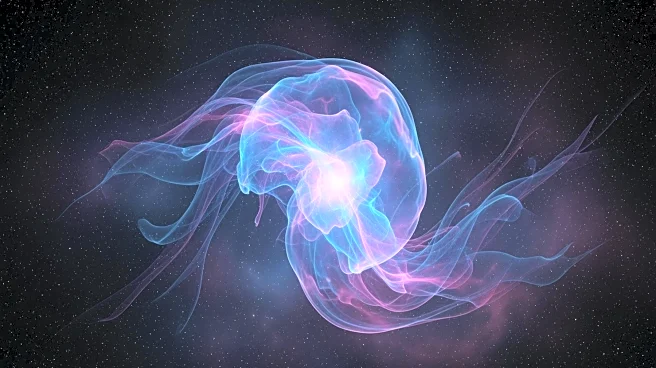
Astrophotographer Ogetay Kayali has captured a breathtaking image of the Jellyfish Nebula, IC 443, located 5,000 light-years from Earth in the constellation Gemini. The nebula, a supernova remnant, features a shell-like structure resembling a jellyfish
or a human brain. Kayali's composition highlights the nebula's luminous shell and the intricate shock fronts where stellar debris collides with interstellar gas. The image was captured over 17 hours using a William Optics Redcat 51 III WFID telescope and a ZWO ASI2600MM astronomy camera, showcasing the nebula's interaction with its surroundings.
Why It's Important?
This image of the Jellyfish Nebula not only showcases the beauty of the cosmos but also provides valuable insights into the aftermath of supernovae. The nebula's structure and the interaction of stellar debris with interstellar gas offer clues about the life cycle of stars and the dynamics of the universe. Such astrophotography can inspire interest in astronomy and contribute to our understanding of cosmic phenomena, potentially leading to new discoveries in space science.
Beyond the Headlines
The Jellyfish Nebula's resemblance to both a jellyfish and a human brain highlights the interconnectedness of natural forms across different scales and environments. This visual analogy can spark curiosity and discussions about the patterns and structures found in nature, from the microscopic to the cosmic level. Additionally, the use of advanced astrophotography techniques demonstrates the growing accessibility of space exploration to amateur astronomers, fostering a broader appreciation for the universe.