

What's Happening?
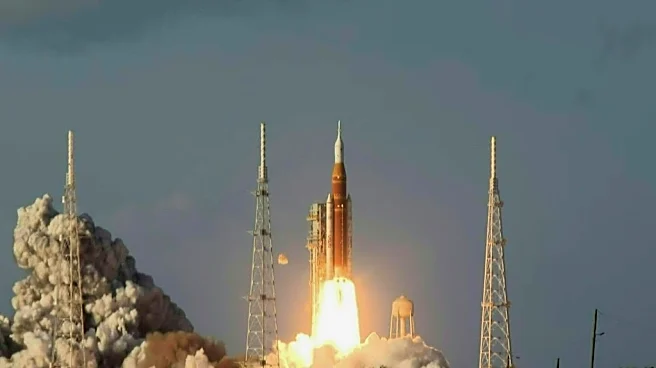
The Artemis II mission, launched by NASA, encountered a technical issue with the Orion spacecraft's toilet system shortly after liftoff. The crew, consisting of NASA astronauts Christina Koch, Victor Glover, Reid Wiseman, and Canadian Space Agency astronaut Jeremy
Hansen, reported a blinking fault light related to the toilet fan, which is responsible for removing odor and airborne particles. The malfunction temporarily affected the urine collection system, although the solid waste system remained operational. NASA's mission control in Houston worked with the astronauts to troubleshoot and resolve the issue, restoring the toilet to normal operations. This mission marks the first crewed flight beyond low Earth orbit since the Apollo 17 mission in 1972, and aims to test systems for future lunar landings.
Why It's Important?
The successful resolution of the toilet malfunction is crucial for the comfort and hygiene of astronauts on long-duration space missions. The Artemis II mission is a significant step in NASA's plan to return humans to the moon and establish a permanent lunar base by 2028. The mission's success in overcoming technical challenges demonstrates the resilience and problem-solving capabilities of both the crew and ground teams. This mission is part of a broader effort to advance human space exploration, with implications for future missions to Mars and beyond. Ensuring reliable life-support systems, including waste management, is essential for the sustainability of long-term human presence in space.
What's Next?
Following the resolution of the toilet issue, the Artemis II crew will continue their 10-day mission, orbiting the moon and testing the spacecraft's capabilities. The mission is a precursor to Artemis III, which aims to land astronauts on the lunar surface. NASA plans to use the insights gained from Artemis II to refine systems for future missions, including the establishment of a lunar base. The success of Artemis II will inform the development of technologies and protocols necessary for deep space exploration, paving the way for human missions to Mars.