


What's Happening?
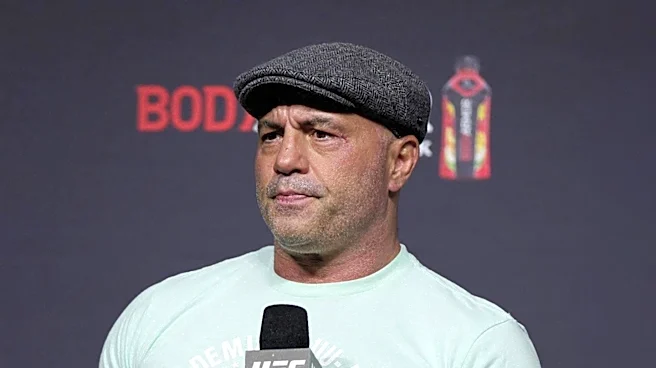
Podcaster Joe Rogan has drawn criticism on social media after describing supporters of President Trump as 'f---ing nuts' and 'rabid' during a recent episode of 'The Joe Rogan Experience.' The comments were made in a discussion with comedian Ron White
regarding the backlash country music star Jelly Roll received for making jokes about President Trump while guest-hosting 'Jimmy Kimmel Live!' Rogan suggested that Trump represents more than just a person to his supporters, viewing him as a leader they believe will 'save us.' This perspective, according to Rogan, is a broader societal issue where leaders are seen as fundamentally different from others. Rogan's remarks have led to mockery and criticism online, with many social media users highlighting his past endorsement of President Trump during the 2024 presidential election. Some users posted screenshots and comments recalling Rogan's previous support for Trump, including a post where he praised Elon Musk for making a compelling case for Trump.
Why It's Important?
Joe Rogan's comments are significant as they highlight the evolving and often contradictory nature of political discourse among influential public figures. Rogan, known for his wide-ranging discussions and large audience, previously offered an endorsement for President Trump, making his recent criticism of Trump's base particularly noteworthy. This shift in tone could impact how his audience, which includes a diverse political spectrum, perceives his political commentary. For Trump supporters, Rogan's remarks may be seen as a betrayal, potentially alienating a segment of his listenership. Conversely, those critical of President Trump might view Rogan's statements as a belated acknowledgment of issues they have long raised. The incident also underscores the intense polarization within U.S. politics, where even seemingly minor criticisms of political figures can ignite significant public debate and social media backlash, affecting public perception and potentially influencing political narratives.
What's Next?
The immediate aftermath of Rogan's comments will likely involve continued social media discussion and analysis from various media outlets. It remains to be seen if Rogan will address the backlash directly in future podcast episodes or if his stance on President Trump and his supporters will continue to evolve. The incident could prompt further scrutiny of public figures who have previously endorsed political candidates but later express reservations about their base. This situation may also lead to broader conversations about the role of podcasters and other non-traditional media personalities in shaping political opinions and the expectations placed upon them by their audiences. Depending on the sustained reaction, it could influence Rogan's future guest selections or the topics he chooses to discuss, particularly concerning U.S. politics and the upcoming election cycle.
Beyond the Headlines
Beyond the immediate controversy, Rogan's comments touch upon deeper societal trends regarding political leadership and follower psychology. His observation that supporters view President Trump as a figure who will 'save us' speaks to a broader phenomenon of hero-worship in politics, where leaders are elevated beyond ordinary individuals. This can lead to intense loyalty and a strong emotional response to any perceived criticism, as evidenced by the backlash against Jelly Roll and now Rogan himself. The incident also highlights the challenges public figures face in navigating their personal political views versus the expectations of their diverse audiences, especially when their past statements are easily accessible. It underscores the difficulty of maintaining a consistent public image in an era of constant digital scrutiny and the potential for past endorsements to complicate present criticisms, revealing the complex interplay between celebrity, politics, and public perception in modern America.