



What's Happening?
Recent research explores the possibility that gravity behaves differently on large scales, potentially explaining dark matter phenomena without the need for new particles. The study, published in Physics Letters B, suggests that Newton's gravitational
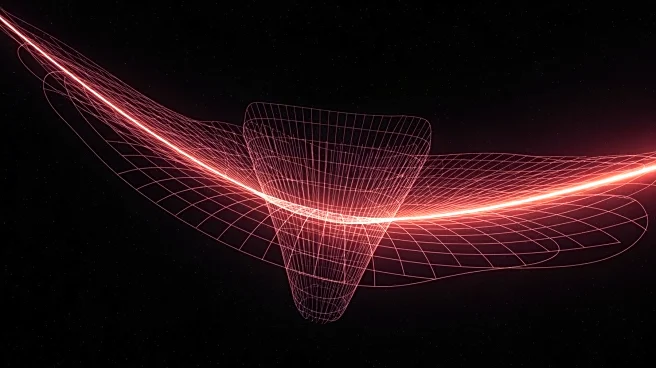
constant may vary at cosmic distances, leading to a modified gravitational potential with a logarithmic correction. This adjustment could account for the flat rotation curves observed in galaxies, traditionally attributed to dark matter halos. The research proposes that gravity's effective strength shifts over galactic distances, offering a field-theoretic route to understanding dark matter effects.
Why It's Important?
This research challenges the conventional understanding of dark matter by suggesting that its effects could be a result of gravity's behavior at large scales. If validated, this theory could reshape the field of cosmology and our understanding of the universe's structure. It offers a potential alternative to the particle dark matter hypothesis, which has dominated scientific discourse for decades. The implications extend to cosmological models, as any changes in gravity must align with precision measurements from the early universe. This approach invites a reevaluation of the origins of dark matter effects and highlights the complexity of gravitational interactions.
What's Next?
Further investigation is needed to explore the phenomenology of infrared-running gravity in cosmological contexts, such as gravitational lensing and cluster dynamics. Upcoming surveys could provide data to distinguish this scenario from particle dark matter alternatives. Researchers aim to identify potential signatures that could validate this theory and further our understanding of gravity's role in cosmic phenomena. The study opens new avenues for theoretical and observational research, potentially leading to a paradigm shift in how dark matter is conceptualized.