



What's Happening?
The Dark Energy Survey (DES) collaboration, comprising over 400 scientists across seven countries, has consistently found that the universe is composed of approximately 30% matter and 70% dark energy. This finding aligns with the Lambda-CDM theory, which
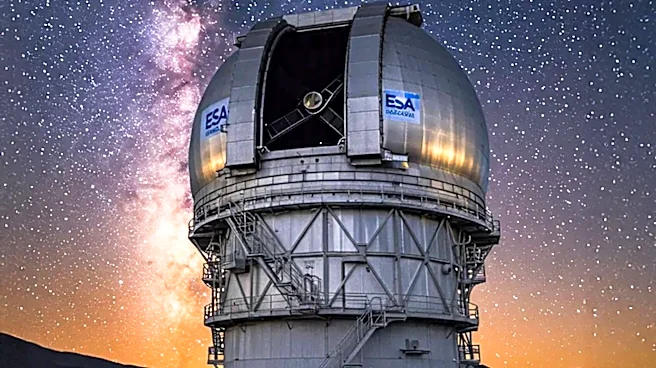
posits that most of this matter is invisible 'cold dark matter' (CDM) and dark energy acts as an unchanging property of the vacuum of space, driving the universe's accelerated expansion. DES utilizes three primary methods to assess dark matter: measuring the clustering of visible galaxies to infer surrounding dark matter, mapping how visible matter distorts background light, and similarly mapping foreground dark matter. These observations, collected over 758 nights between 2013 and 2019 using the 570-megapixel Dark Energy Camera on the Blanco telescope in Chile, have significantly increased the number of recorded galaxies to hundreds of millions. While consistent with the Lambda-CDM model, recent data from a next-generation experiment, DESI, combined with DES observations and sharper cosmic microwave background images, suggest that the Lambda-CDM theory may no longer fully fit, hinting at potential missing elements in our understanding of the cosmos.
Why It's Important?
The findings from the Dark Energy Survey are crucial for advancing our fundamental understanding of the universe's composition and evolution. The consistent validation of the Lambda-CDM theory through DES data reinforces our current cosmological model, which has significant implications for theoretical physics and astrophysics. However, the emerging discrepancies when DES data is combined with newer observations from DESI indicate that our current models might be incomplete. This could lead to a paradigm shift in cosmology, prompting scientists to explore new theories of dark matter, dark energy, or even modifications to general relativity. Such developments could influence future research funding, the direction of large-scale astronomical projects, and the development of new observational technologies. The ongoing quest to reconcile these observations could unlock deeper insights into the fundamental forces and particles governing the universe, potentially leading to breakthroughs that redefine our place in the cosmos.
What's Next?
Future research will likely focus on resolving the discrepancies between the Lambda-CDM theory and the combined data from DES and DESI. The DESI experiment, with its thousands of tiny eyes capable of precisely capturing galaxy motions, is expected to provide more detailed insights into hidden cosmic structures and the universe's expansion rate over the past 10 billion years. Scientists will continue to combine data from various sources, including the cosmic microwave background, to refine cosmological models. This ongoing analysis may lead to the development of new theoretical frameworks that better explain the observed universe, potentially involving new particles or forces. The scientific community will be keenly watching for further results from DESI and other next-generation experiments, as they could either confirm the need for new physics or provide a more nuanced understanding of existing theories. The search for a more complete cosmological model will drive international collaborations and technological advancements in astronomy and particle physics.
Beyond the Headlines
The persistent mystery of dark matter and dark energy, despite extensive research, highlights the limitations of our current scientific understanding and the vastness of the unknown in the universe. The potential for a 'missing element' in the Lambda-CDM theory underscores the dynamic nature of scientific inquiry, where established models are continuously tested and refined. This pursuit has broader philosophical implications, challenging our perceptions of reality and the fundamental laws governing existence. The collaborative nature of projects like DES, involving hundreds of scientists across multiple countries, exemplifies the global effort required to tackle such profound questions. The ethical considerations of scientific discovery, particularly in areas that could redefine our understanding of the universe, also come into play, emphasizing the importance of rigorous methodology and open discourse. Ultimately, the quest to understand dark matter and dark energy is not just about physics; it's about humanity's enduring curiosity and its drive to comprehend the cosmos.