



What's Happening?
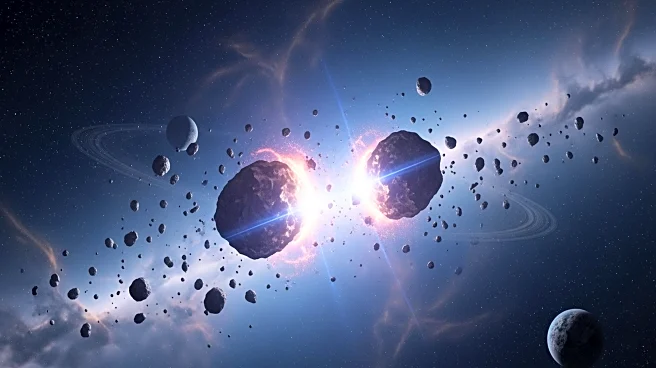
The Hubble Space Telescope has captured a rare event in the Fomalhaut star system, located 25 light-years from Earth. Astronomers observed a collision between two asteroids, each approximately 60 kilometers in diameter. This collision resulted in a massive
debris cloud, providing a unique opportunity to study the processes that lead to planet formation. The Fomalhaut system, a young star surrounded by a debris disk, serves as a natural laboratory for understanding these early planetary processes. Previously, a similar event was observed in the same system, leading to the identification of a bright object initially thought to be a planet, later determined to be a dust cloud from a collision. The recent observations have been named Fomalhaut cs2, following the earlier event labeled as Fomalhaut cs1.
Why It's Important?
This discovery is significant as it offers insights into the early stages of planet formation, a process not directly observable in our own Solar System. The frequent collisions in the Fomalhaut system suggest a dynamic environment where planetesimals, the building blocks of planets, are actively interacting. Understanding these collisions helps astronomers estimate the size and number of such bodies in the debris disk, providing crucial data for models of planetary system development. The findings also serve as a cautionary note for future missions aiming to detect exoplanets, as dust clouds can mimic planetary signals.
What's Next?
Astronomers plan to continue monitoring Fomalhaut cs2 using both the Hubble Space Telescope and the James Webb Space Telescope (JWST). They aim to observe changes in the shape, brightness, and orbit of the debris cloud over time. These observations will help determine the long-term evolution of the collision remnants and provide further insights into the processes governing planet formation. The ongoing study of the Fomalhaut system will contribute to a better understanding of how planets form and evolve in other star systems.