





What's Happening?
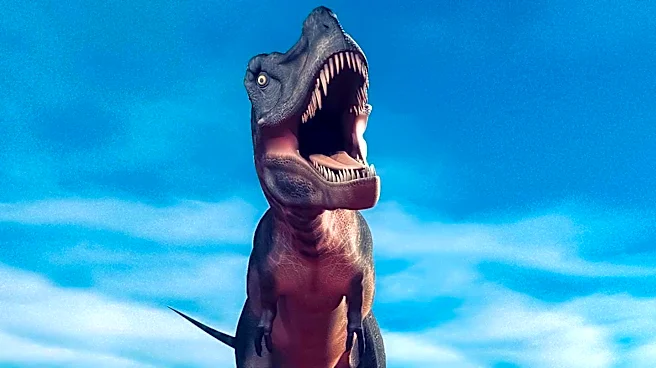
Kent Hups, a science teacher from Northglenn High School, discovered a never-before-seen Tyrannosaurus Rex trackway in the Badlands of North Dakota on July 9, 2025. Hups was volunteering with the Denver Museum of Nature and Science when he made the find.
Initially, he was skeptical, as T. Rex tracks are rarely found in the Hell Creek Formation due to the swampy conditions that typically wash away or fill in tracks. However, upon closer inspection, he identified the large footprints as belonging to a T. Rex, a conclusion later confirmed by Tyler Lyson, senior curator of vertebrate paleontology at the Denver Museum of Nature and Science. This discovery is considered astronomically rare, as all previously found T. Rex skeletons have been located in the Hell Creek Formation, which spans North Dakota, Wyoming, and Montana. The T. Rex bones found in Colorado are from a similar time period.
Why It's Important?
This discovery holds significant scientific importance as it marks the first-ever T. Rex trackway found, providing new insights into the locomotion and behavior of these gigantic carnivorous dinosaurs. While T. Rex skeletons have been extensively studied, direct evidence of their movement through trackways is exceptionally rare. This find could help paleontologists understand how T. Rexes walked, their stride length (estimated at 13 feet), and their speed (approximately four mph). It challenges previous assumptions about the preservation of tracks in the Hell Creek Formation, potentially opening new avenues for future paleontological searches. For the public, it offers a tangible connection to prehistoric life, with three steps from the trackway slated for display in Denver, enhancing educational opportunities and public engagement with science.
What's Next?
Three steps from the newly discovered T. Rex trackway are scheduled to be put on display in Denver this winter, allowing the public to view this rare paleontological find. Kent Hups and another Northglenn teacher have already created a 3D-printed replica of one of the footprints, which will be kept at the high school for educational purposes. Further scientific analysis of the trackway is expected to provide more detailed information about the T. Rex's gait, weight distribution, and interaction with its environment. The discovery may also encourage more extensive searches for similar trackways in the Hell Creek Formation and other regions, potentially leading to additional groundbreaking finds that could reshape our understanding of dinosaur behavior.
Beyond the Headlines
The discovery of the T. Rex trackway transcends a mere scientific find; it underscores the ongoing potential for significant paleontological discoveries in seemingly well-explored regions. It highlights the critical role of citizen scientists and volunteers, like Kent Hups, in contributing to scientific advancement. The initial skepticism surrounding the find, followed by rigorous scientific verification, exemplifies the scientific method in action. Furthermore, the creation of a 3D-printed replica for educational use demonstrates an innovative approach to bringing scientific discoveries directly into classrooms, fostering a deeper appreciation for paleontology and inspiring future generations of scientists. This event also subtly reminds us of the vast, unexplored history embedded within our planet's geological formations.