









What's Happening?
The Canadian federal government has announced an investment of up to $1.65 million in a Toronto-based technology company, A.U.G. Signals Ltd., to develop artificial intelligence tools aimed at assisting Canadian farmers. This initiative, part of the AgriScience
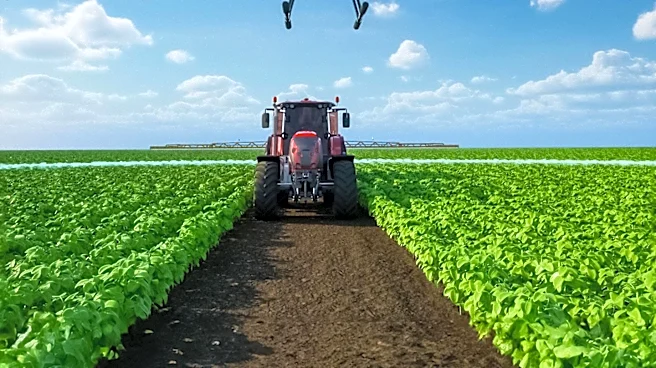
Program under the Sustainable Canadian Agricultural Partnership, focuses on creating AI-powered tools that integrate satellite imagery, drone data, and field observations. These tools are designed to provide real-time information on crop health, biomass, drought conditions, and yield forecasts. The project involves collaboration with Agriculture and Agri-Food Canada to collect field data and validate AI models, with the goal of improving decision-making on farms and helping producers adapt to climate change.
Why It's Important?
This investment is significant as it underscores the growing role of technology in agriculture, particularly in enhancing productivity and sustainability. By leveraging AI and remote sensing, the initiative aims to strengthen the competitiveness of Canada's agricultural sector. The development of these tools is expected to help farmers better manage resources and respond to climate challenges, potentially leading to increased resilience and sustainability in agriculture. The project also highlights the importance of collaboration between industry, researchers, and government in driving innovation and addressing environmental challenges.
What's Next?
As the project progresses, A.U.G. Signals Ltd. will continue to work with Agriculture and Agri-Food Canada to refine and validate the AI models. The success of this initiative could pave the way for broader adoption of AI technologies in agriculture, potentially influencing policy decisions and encouraging further investments in similar technologies. Stakeholders in the agricultural sector may closely monitor the outcomes to assess the effectiveness of AI in improving farm productivity and sustainability.
Beyond the Headlines
The integration of AI in agriculture not only promises to enhance productivity but also raises questions about data privacy and the ethical use of technology in farming. As AI tools become more prevalent, there will be a need to address concerns related to data ownership and the potential impact on traditional farming practices. Additionally, the success of such initiatives could lead to a shift in how agricultural education and training are approached, emphasizing the importance of technological literacy among farmers.