



What's Happening?
Representative Jin Sung-joon, chair of South Korea's National Assembly’s National Defense Committee, announced that the United States remains committed to the conditions-based transfer of wartime operational control (OPCON) to Seoul. This reaffirmation
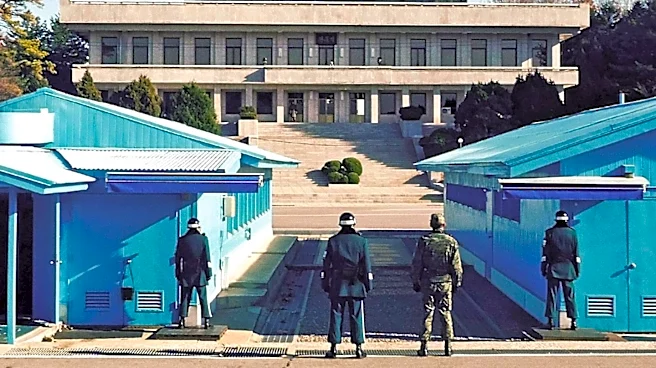
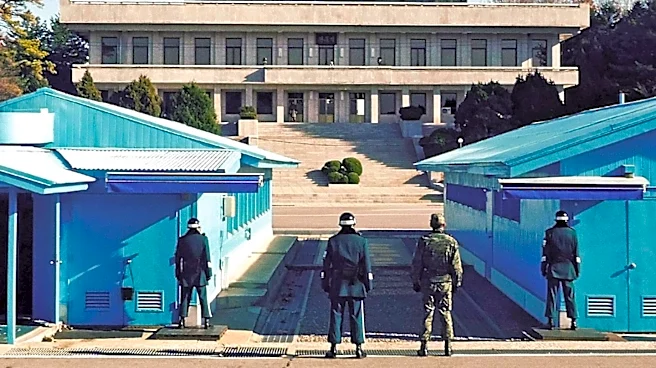
comes despite uncertainties surrounding U.S. midterm elections. Following a parliamentary delegation visit to the U.S. from November 1 to 5, Jin reported that U.S. officials attributed the postponement of the Korea-U.S. Security Consultative Meeting to scheduling conflicts rather than disagreements over the OPCON transfer. U.S. officials assessed the security situation on the Korean Peninsula as stable, even with recent North Korean actions in the Demilitarized Zone (DMZ), such as the demolition of inter-Korean connecting roads and fortification along the Military Demarcation Line (MDL). However, they emphasized the necessity of maintaining military readiness due to North Korea's evolving nuclear and missile capabilities and potential abrupt policy shifts. Additionally, Adm. Stephen T. Koehler, commander of the U.S. Pacific Fleet, indicated that South Korea's pursuit of nuclear-powered submarines could strengthen the alliance, expressing willingness to cooperate pending policy decisions from both governments.
Why It's Important?
The U.S. reaffirmation of its commitment to the OPCON transfer is crucial for regional stability and the U.S.-South Korea alliance. This commitment signals continuity in defense policy, reassuring South Korea that bilateral agreements will be honored regardless of U.S. domestic political shifts. The emphasis on maintaining military readiness underscores the persistent threat posed by North Korea's growing military capabilities, highlighting the strategic importance of a robust U.S. presence and collaborative defense posture in the Indo-Pacific. Furthermore, the discussion around South Korea acquiring nuclear-powered submarines indicates a potential enhancement of allied military capabilities, which could significantly alter the regional power balance and deterrence against North Korean aggression. Such a development would require careful policy coordination between Washington and Seoul, impacting defense industrial cooperation and strategic planning for both nations.
What's Next?
The postponed Security Consultative Meeting between Korea and the U.S. is expected to be rescheduled for next year, where further discussions on the OPCON transfer and broader security cooperation will likely take place. Both governments will need to make policy decisions regarding South Korea's potential acquisition of nuclear-powered submarines, which could lead to increased technological and military collaboration. Continued monitoring of North Korea's actions in the DMZ and its nuclear and missile programs will remain a priority, influencing the pace and scope of military readiness efforts. The U.S. will likely continue to engage with South Korea to ensure a coordinated response to regional security challenges, potentially involving joint military exercises and intelligence sharing to maintain deterrence and stability on the Korean Peninsula.
Beyond the Headlines
The ongoing commitment to OPCON transfer reflects a deeper strategic evolution in the U.S.-South Korea alliance, moving towards a more balanced and collaborative defense framework. This shift could empower South Korea with greater autonomy in its defense while maintaining strong U.S. support. The potential for South Korea to acquire nuclear-powered submarines raises significant implications for non-proliferation efforts and regional arms control, potentially influencing other nations' defense strategies. It also highlights the complex interplay between national security interests, technological advancements, and alliance dynamics in a volatile geopolitical landscape. The U.S. approach to these discussions will set precedents for how it manages alliances and security commitments in other critical regions, underscoring the long-term strategic vision for maintaining peace and stability in the Indo-Pacific.