



What's Happening?
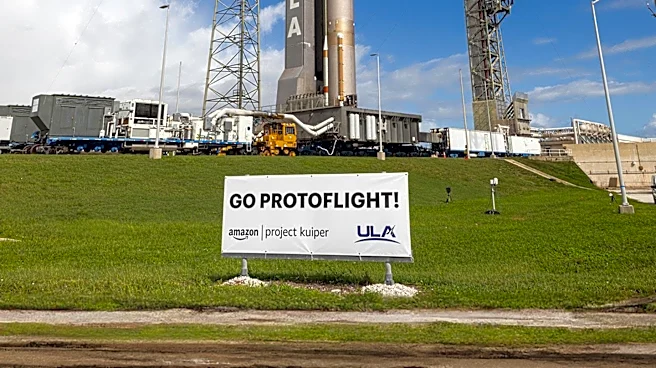
United Launch Alliance (ULA) is set to return its Vulcan rocket to flight this weekend, marking its first launch for the Amazon Leo constellation. The launch is scheduled for Saturday, November 14, at 12:32 p.m. ET from Cape Canaveral Space Force Station
in Florida. The Vulcan rocket had been out of service since February due to an anomaly with its solid rocket motors, manufactured by Northrop Grumman. Although the February launch for the U.S. Space Force was successful, the Space Force suspended subsequent Vulcan launches for the National Security Space Launch (NSSL) program to allow for an investigation and resolution of the anomaly. ULA, in collaboration with its team, Northrop Grumman, the Space Force, and other government agencies, has since made and thoroughly tested changes to the rocket's nozzle.
Why It's Important?
This return to flight for the Vulcan rocket is critical for both ULA and Amazon Leo. For ULA, it signifies the successful resolution of a significant technical issue, restoring confidence in its launch capabilities for national security and commercial missions. The U.S. Space Force's decision to suspend launches underscored the importance of reliability in space launch systems, particularly for sensitive NSSL programs. For Amazon Leo, this launch marks the beginning of a 'sprint' of Vulcan launches, with 40 Amazon Leo satellites on board, representing the largest launch yet for the constellation. Amazon Leo's director of launch systems, Melissa Wuerl, highlighted that larger rockets and more frequent launches are essential for scaling their constellation and delivering services to customers. The Vulcan rocket is expected to be the primary workhorse for launching nearly half of Amazon's first-generation constellation, making its reliability paramount for Amazon's commercial space ambitions.
What's Next?
The upcoming launch on November 14 will be the first of 38 Vulcan rocket launches planned for Amazon, following eight previous missions with the Atlas V rocket. This mission will utilize the Vulcan VC6L variant, featuring the Centaur V upper stage and six side-mounted solid rocket boosters. The successful execution of this launch will be a crucial step for Amazon Leo in rapidly deploying its constellation to provide internet services. For ULA, a successful launch will reinforce its position as a key player in the competitive space launch market, potentially leading to more contracts from both government and commercial clients. The space industry will closely monitor the performance of the modified Vulcan rocket, as its reliability directly impacts the deployment schedules and operational capabilities of critical satellite networks.
Beyond the Headlines
The Vulcan rocket's return to flight after addressing a technical anomaly highlights the inherent risks and complexities of space launch operations. The collaboration between ULA, Northrop Grumman, and the U.S. Space Force in investigating and resolving the issue demonstrates the rigorous safety and reliability standards demanded by national security space programs. This event also underscores the growing convergence of commercial and military interests in space, with commercial constellations like Amazon Leo relying on launch providers that also serve defense needs. The success or failure of such launches can have significant economic implications for companies involved and strategic consequences for national space capabilities. Furthermore, the increasing frequency of large-scale satellite deployments, driven by commercial ventures, contributes to the growing challenge of space traffic management and the potential for orbital debris, raising long-term environmental and operational concerns for all space users.