
What's Happening?
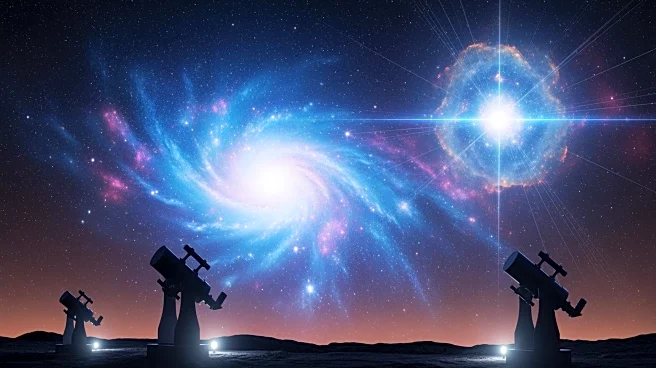
Astronomers using the Gemini North and Blanco telescopes have uncovered new insights into the origins of GRB 250702B, the longest gamma-ray burst ever observed. Detected on July 2, 2025, this event lasted
over seven hours, a record duration for such phenomena. The burst was first identified by NASA's Fermi Gamma-ray Space Telescope, and subsequent observations were conducted using various ground-based telescopes. The data suggest that the gamma-ray burst originated from a galaxy outside the Milky Way, shrouded in significant interstellar dust. Researchers propose several potential scenarios for the burst's origin, including interactions involving black holes and neutron stars.
Why It's Important?
The study of GRB 250702B provides valuable insights into the extreme events that occur in the universe. Understanding gamma-ray bursts, which are among the most powerful explosions since the Big Bang, can enhance our knowledge of cosmic phenomena and the conditions that lead to such events. This research also highlights the capabilities of modern telescopes in capturing and analyzing distant cosmic occurrences, contributing to the broader field of astrophysics. The findings could have implications for theoretical models of stellar evolution and the behavior of compact objects like black holes and neutron stars.
What's Next?
Further observations and analyses are needed to conclusively determine the cause of GRB 250702B. The data collected so far supports multiple origin scenarios, but additional research could refine these theories and improve our understanding of gamma-ray bursts. Continued advancements in telescope technology and data analysis methods will likely play a crucial role in future discoveries. The ongoing study of such cosmic events will contribute to the development of more accurate models of the universe's most extreme phenomena.





