





What's Happening?
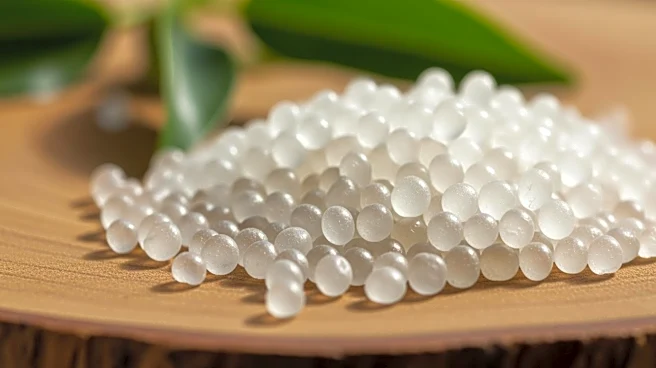
Researchers have created a new type of plastic, termed 'living plastic', which can completely break down after use. This innovative material contains dormant bacteria embedded within the plastic, which, when activated by heat and nutrients, release enzymes
that dismantle the plastic from within. The material, made from polycaprolactone, behaves like ordinary plastic until activation, after which it degrades completely within six days. This development aims to address the issue of plastic waste accumulation by allowing short-lived plastics to disappear after use rather than persisting as waste. The research was conducted by Zhuojun Dai, Ph.D., at the Shenzhen Institute of Advanced Technology (SIAT).
Why It's Important?
The development of 'living plastic' represents a significant advancement in addressing the global plastic waste problem. Traditional plastics are durable and persist in the environment long after their useful life, contributing to pollution. By enabling plastics to self-destruct after use, this technology could reduce the environmental impact of plastic waste. This innovation could be particularly beneficial for single-use plastics, which are a major contributor to pollution. However, the technology requires controlled conditions for activation, which means it may not be suitable for all disposal scenarios. The potential for this technology to be applied to various types of plastics could lead to a significant reduction in plastic waste if implemented on a large scale.
What's Next?
For 'living plastic' to be widely adopted, further research and development are needed to ensure that the technology can be applied to a broader range of plastic types. Additionally, systems for controlled activation and disposal need to be developed to maximize the effectiveness of this technology. The researchers are also exploring the potential for this technology to be used in temporary medical or fitness sensors, which could degrade after use, reducing electronic waste. The success of this technology will depend on its ability to be scaled up for mass production and its integration into existing waste management systems.