




What's Happening?
Chinese scientists have successfully completed sea testing for the Tropical Deep-sea Neutrino Telescope (TRIDENT), a major underwater telescope project in the South China Sea. The project, led by Shanghai Jiao Tong University (SJTU), aims to build a world-leading
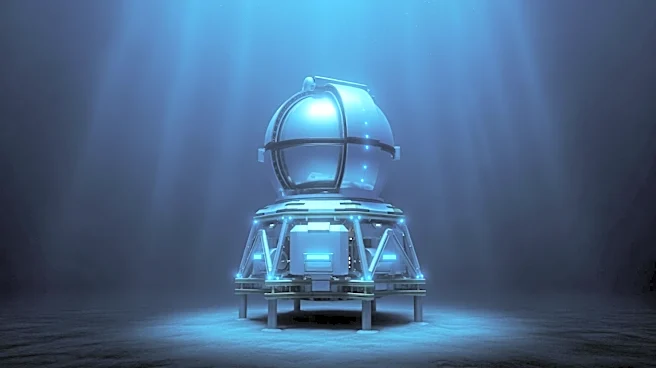
neutrino detection system to explore high-energy cosmic phenomena. The testing involved deploying precision instruments at a depth of 3,500 meters, focusing on technological breakthroughs such as the subsea precision instrument deployer (SPIDER) system, underwater acoustic positioning, and deep-sea connectors. The SPIDER system successfully completed a seabed landing test and demonstrated precision positioning capabilities. The project seeks to capture high-energy neutrino signals to advance research in particle physics, astronomy, and ocean engineering.
Why It's Important?
The TRIDENT project represents a significant advancement in scientific research, particularly in the fields of particle physics and astrophysics. By capturing high-energy neutrinos, the project could provide insights into the origins of cosmic rays and other extreme astrophysical phenomena. This research has the potential to enhance our understanding of the universe and contribute to interdisciplinary studies across various scientific domains. Additionally, the project's success underscores China's growing capabilities in deep-sea exploration and technology, positioning the country as a leader in cutting-edge scientific research.