








What's Happening?
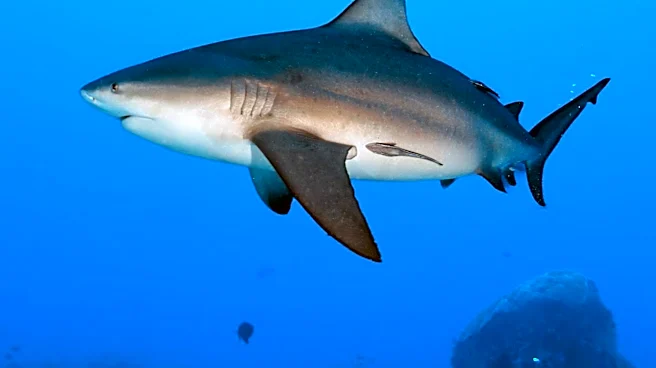
For several weeks, the city of Busan in South Korea has been captivated by an unexpected visitor: a Dusky shark nicknamed Bukangi. This shark swam into a city canal and has remained there, despite repeated attempts by experts to guide her back to the open
sea. The efforts to relocate Bukangi have been live-streamed, turning her into a local celebrity. She has become the unofficial mascot of Busan, with merchandise and cartoon posters featuring her image. Bukangi's presence has reportedly boosted tourism and visitor numbers to the city. While her celebrity status is growing, her unusual presence in the canal has also prompted discussions among experts and climate reporters about potential links to climate change.
Why It's Important?
Bukangi's prolonged stay in the Busan canal is significant as it highlights potential ecological shifts that could be influenced by climate change. The unusual behavior of a Dusky shark, typically an open-ocean species, venturing and remaining in a city canal, raises questions about changes in marine environments, water temperatures, or food availability that might be driving such occurrences. While Bukangi's presence has brought positive attention and tourism to Busan, it also serves as a natural indicator of broader environmental concerns. The public's engagement with Bukangi, through live streams and merchandise, demonstrates a unique opportunity to raise awareness about marine conservation and the impacts of climate change on ocean ecosystems. Understanding the reasons behind Bukangi's behavior could provide valuable insights into how marine life is adapting or struggling with changing climatic conditions.
What's Next?
Experts will likely continue to monitor Bukangi's behavior and the environmental conditions in the Busan canal to understand why she has chosen to remain there. Further research may be conducted to investigate potential links between her presence and climate change indicators, such as changes in local water temperatures or prey distribution. The city of Busan may leverage Bukangi's popularity to further promote marine conservation efforts and environmental awareness campaigns. The ongoing public interest in Bukangi could also lead to increased funding or support for scientific studies on shark behavior and climate change impacts on marine ecosystems. The situation could also prompt discussions on urban planning and how human infrastructure interacts with natural habitats, especially in coastal areas.
Beyond the Headlines
Bukangi's story transcends a simple animal sighting; it embodies a complex interplay between urban development, wildlife, and the global climate crisis. Her transformation into a local mascot reflects a human tendency to connect with nature, even in unexpected urban settings, and highlights the power of individual stories to capture public imagination. However, the underlying question of why she is there points to a deeper ecological narrative. It forces a reflection on how human activities and climate change are altering natural habitats and pushing wildlife into new, often precarious, environments. The phenomenon of 'climate refugees' is often discussed in human terms, but Bukangi's situation could be seen as a poignant example of an animal potentially displaced or affected by environmental shifts. This raises ethical considerations about human responsibility towards wildlife in a rapidly changing world and the need for proactive conservation strategies that consider the broader impacts of climate change.