

What's Happening?
U.S. Senator Pete Ricketts, a Republican from Nebraska and son of a billionaire, is currently in a closely contested Senate race against independent candidate Dan Osborn. Osborn, a former union president and Navy veteran, is campaigning on a populist
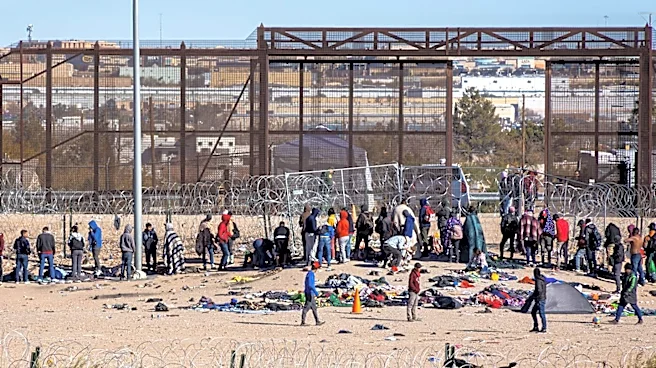
platform, appealing to voters frustrated with both major parties and the influence of wealthy elites in politics. Despite Nebraska being a deeply red state where registered Republicans outnumber Democrats almost two-to-one, recent polls indicate the race is neck and neck. Osborn's campaign emphasizes his working-class background, his leadership in a successful 2021 Kellogg's strike, and his commitment to representing ordinary Nebraskans. He criticizes Senator Ricketts for his family's wealth and perceived alignment with corporate interests, particularly regarding issues like immigration and data center tax breaks. Osborn's independent stance aims to break from the traditional two-party system, which he describes as a 'two-party doom loop' that hinders progress on critical issues.
Why It's Important?
This Senate race in Nebraska is significant as it tests the viability of an independent, populist campaign in a state traditionally dominated by Republicans. A victory for Dan Osborn could signal a growing voter dissatisfaction with established political parties and a desire for candidates perceived as outside the political establishment. For the Republican Party, a loss in Nebraska would be a notable setback, especially given Senator Ricketts' background and the state's strong Republican leanings. The race also highlights broader national themes, such as the influence of money in politics, the struggles of working-class families, and the debate over immigration policy. Osborn's critique of corporate influence and his focus on issues like affordable housing and healthcare resonate with a segment of the electorate feeling economically marginalized. The outcome could influence future campaign strategies for independent candidates and potentially shift the political landscape in other red states.
What's Next?
As the 2026 Senate election approaches, the campaign between Senator Ricketts and Dan Osborn is expected to intensify. Osborn will likely continue to leverage his populist message, focusing on his working-class roots and his independence from corporate donors, while Ricketts will likely emphasize his Republican platform and experience. The role of external funding and political action committees will be crucial, as both campaigns seek to sway undecided voters. Debates and public appearances will offer key opportunities for each candidate to articulate their vision for Nebraska and the nation. The race will also be closely watched for its implications on the balance of power in the U.S. Senate, particularly if the overall Senate control is tight. The ability of Osborn to maintain momentum and convert his current polling strength into actual votes will be a critical factor in the coming months.
Beyond the Headlines
The Nebraska Senate race transcends a typical partisan contest, delving into deeper questions about political identity and representation in America. Dan Osborn's independent candidacy challenges the notion that voters in deeply red states are exclusively loyal to the Republican Party. His appeal suggests a potential shift where voters prioritize authenticity and perceived alignment with working-class interests over traditional party affiliations. The campaign also brings to the forefront the ethical implications of wealth in politics, with Osborn directly contrasting his background with Senator Ricketts' billionaire family ties. This dynamic raises questions about whether personal wealth insulates politicians from influence or, conversely, aligns them more closely with elite interests. Furthermore, Osborn's critique of the 'two-party doom loop' reflects a broader national sentiment of frustration with political polarization and gridlock, hinting at a desire for more collaborative and less ideologically rigid governance.