

What's Happening?
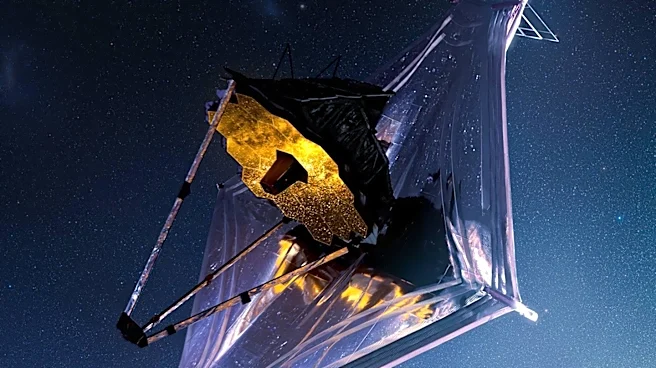
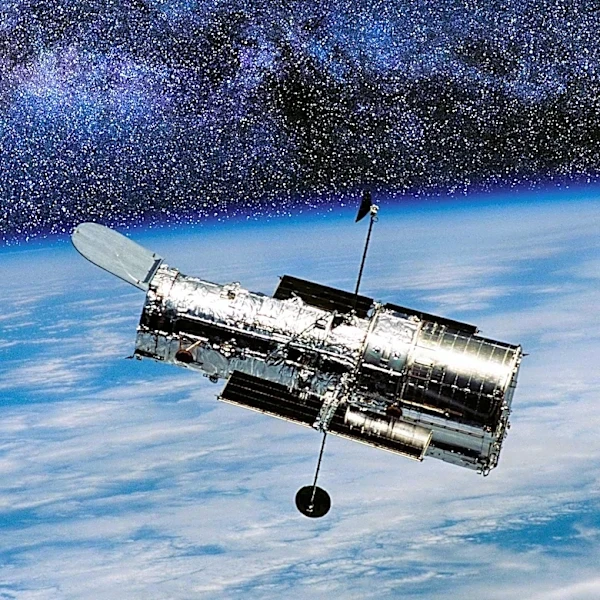
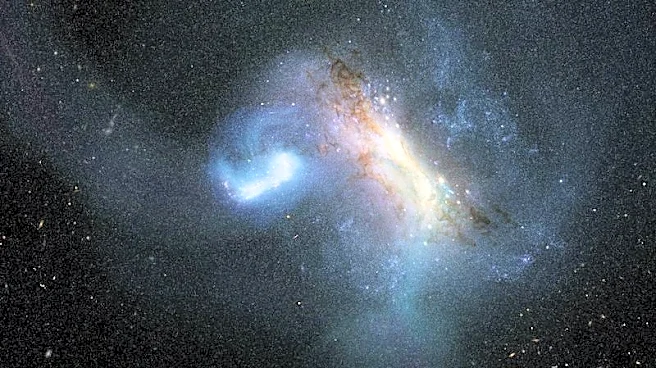
Astronomers, using the James Webb Space Telescope (JWST), have discovered an unusual object from the early universe, approximately 660 million years after the Big Bang. This object, one of the 'little red dots' (LRDs) observed by JWST, is believed to
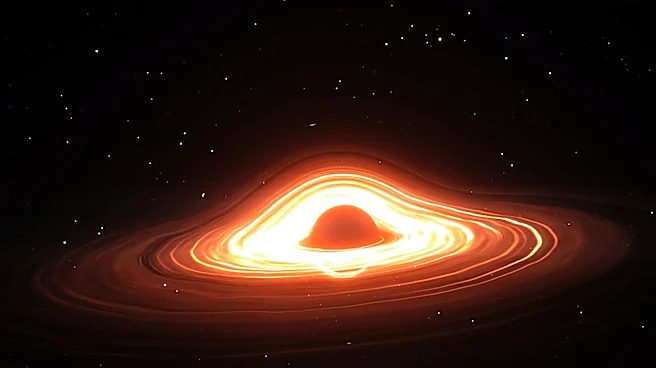
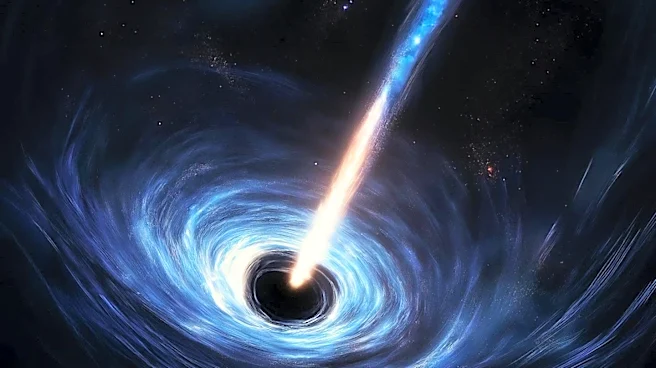
be a rapidly growing supermassive black hole surrounded by an enormous and dense cloud of hydrogen gas. The light from this object, which has traveled over 13 billion years to reach Earth, exhibits a colossal 'Balmer break' in its spectrum, indicating the presence of a large and turbulent quantity of hydrogen gas. This finding challenges the previous assumption that the red color of LRDs was primarily due to dust. Instead, the team's model suggests that the color is explained by this massive gas cocoon, which is estimated to have around 100 billion particles per cubic centimeter and extends millions of kilometers around the black hole. The research, published in Nature, proposes that this dense gas environment allows the black hole to grow much faster than conventional rates, potentially explaining the existence of very massive black holes in the young universe.
Why It's Important?
This discovery significantly impacts our understanding of the early universe and the formation of supermassive black holes. The traditional models struggled to explain how black holes could grow to such immense sizes so quickly after the Big Bang. The 'hydrogen cocoon' hypothesis provides a plausible mechanism for accelerated growth, where the dense gas cloud fuels the black hole while trapping or redistributing radiation that would otherwise limit its accretion rate. This could mean that some early black holes grew much faster than their host galaxies accumulated stars. Furthermore, if the redness of some LRDs is due to gas rather than dust, it could imply that their masses are up to 100 times lower than previously estimated, altering our understanding of the mass distribution of early black holes. This research also highlights the JWST's capability to reveal more complex explanations for cosmic phenomena than previously assumed, moving beyond simpler interpretations like dust obscuration.
What's Next?
The study's authors emphasize that their observation does not conclusively establish the idea, and the exact mechanism for the black hole's formation and its dense envelope remains an open question. Future research will focus on further observations with JWST's NIRSpec instrument to map hydrogen absorption and search for additional spectral lines. Repeated imaging will also be crucial to confirm the observed 30% brightening over 56 rest-frame days, which would support the presence of a compact accreting source. X-ray and radio observations will help constrain how effectively the gas hides the central engine, while deeper imaging will aim to measure the faint host galaxy. Astronomers will also continue to investigate other LRDs to determine if similar gas-rich environments are a common feature, potentially leading to a more comprehensive understanding of the diverse nature of these early cosmic objects.
Beyond the Headlines
This discovery delves into the fundamental questions of cosmic evolution, particularly how the most massive structures in the universe came to be. The idea of 'black hole stars' — black holes cloaked in dense gas that mimic stellar spectra — challenges our basic definitions of celestial objects and the mechanisms of light emission. It suggests that the universe's early stages were far more dynamic and complex than previously imagined, with processes that allowed for rapid growth of black holes under conditions that are not easily replicated today. This research also underscores the iterative nature of scientific discovery, where new observational capabilities like JWST continuously refine and sometimes overturn long-standing theories, pushing the boundaries of human knowledge about the cosmos and its origins.