
What's Happening?
A dinosaur egg found in China's Chishan Formation, dated to approximately 70 million years ago, revealed calcite crystals inside, leading to the identification of a new oospecies, Shixingoolithus qianshanensis.
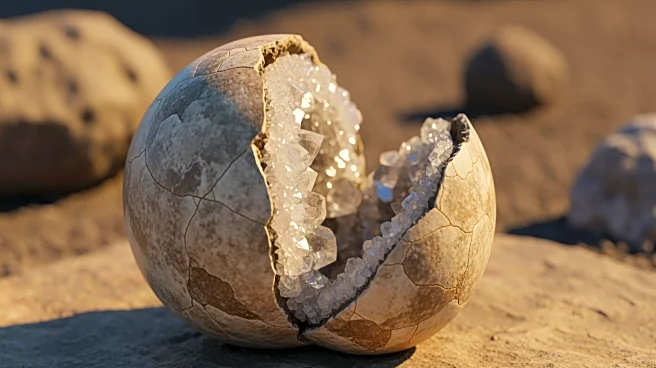
The egg, about the size of a grapefruit, was found at a fossil site and presented an unusual condition with shiny calcite crystals adhered to the inner shell. This configuration transformed the egg into a natural dinosaur geode. The crystals are not part of the egg's original structure but result from processes after burial. The discovery broadens understanding of the local faunal diversity at the end of the Cretaceous period.
Why It's Important?
The discovery of calcite crystals inside the dinosaur egg offers new possibilities for studying fossilization processes and environmental conditions of the Late Cretaceous. The identification of a new oospecies expands the scientific record on dinosaur eggs and their microstructure. The presence of dinosaur eggs in the Chishan Formation suggests that dinosaurs frequented or nested in the area, contributing to reassessing the paleontological importance of the region. The study of calcite crystals can provide relevant information about underground fluids and the geochemical environment of the fossil site.