










What's Happening?
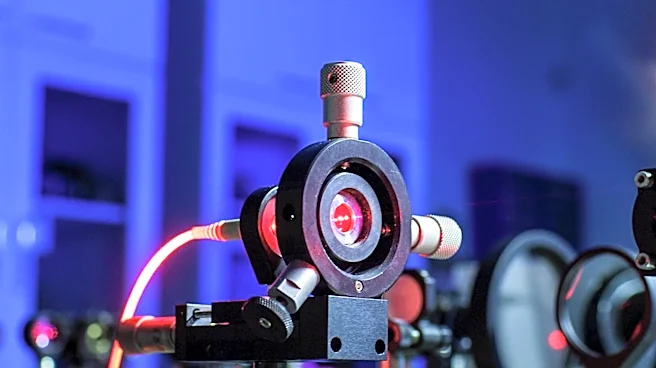
Engineers at the University of California San Diego have developed a new method to control magnetism using light, which could lead to computer memory that is 1,000 times faster than current technology. Published in Nature Communications, this research
focuses on optical switching, a technique that uses light to change magnetic states. Traditional data storage relies on external magnetic fields to alter magnetic regions, a process that is energy-intensive and limits recording speed. The UC San Diego team utilized a specialized ultrafast laser, modifying its beam's shape and size to achieve significantly smaller and more precise energy delivery. This breakthrough allows for faster and more energy-efficient data writing, overcoming previous limitations of optical switching, such as the need for extremely thin magnetic structures and specific light polarization. The researchers successfully demonstrated optical switching in a thicker magnetic structure with nine alternating layers of platinum and cobalt, without requiring a particular light polarization.
Why It's Important?
This advancement holds significant implications for the future of digital data storage and computing. By enabling memory speeds 1,000 times faster than conventional methods, it could revolutionize various U.S. industries reliant on rapid data processing, including finance, artificial intelligence, and scientific research. The ability to store more information in a smaller physical space would also lead to more compact and powerful electronic devices, impacting consumer electronics and enterprise data centers. Furthermore, the reduced energy consumption associated with optical switching could contribute to more sustainable computing infrastructure, addressing growing concerns about the environmental impact of data centers. This technology could also foster innovation in related fields, such as quantum computing and advanced materials science, by providing new tools for manipulating matter at the nanoscale. The U.S. technology sector stands to gain a competitive edge through the development and adoption of such high-speed, high-density memory solutions.
What's Next?
While the research presents promising possibilities, significant technical hurdles remain before optical switching can be integrated into everyday electronic devices. A primary challenge is the specialized ultrafast laser currently required, which is not easily incorporated into computer chips. The researchers are exploring alternative approaches, including identifying magnetic materials that are responsive to more readily integrable laser systems. They also aim to further reduce the laser beam's size to just a few hundred nanometers by developing optical structures capable of concentrating light into even smaller regions. These ongoing efforts are focused on understanding how precisely engineered light can manipulate magnetism at extremely small scales. If these engineering challenges are overcome, the approach could pave the way for a new generation of compact, high-density memory devices capable of writing digital information at significantly greater speeds, potentially leading to commercial applications within the next decade.
Beyond the Headlines
The development of ultrafast, high-density computer memory through optical switching extends beyond mere speed and storage capacity. It represents a fundamental shift in how we interact with and process information, potentially enabling entirely new paradigms in computing. The ability to manipulate magnetic states with light at an atomic scale could unlock advancements in areas like neuromorphic computing, which seeks to mimic the human brain's structure and function. This technology could also have profound implications for cybersecurity, allowing for faster encryption and decryption processes, and for scientific discovery, by enabling more complex simulations and data analysis. The interdisciplinary nature of this research, combining optics and magnetic materials, highlights a growing trend in scientific innovation where breakthroughs often emerge at the intersection of traditionally separate fields. This collaborative approach could accelerate the development of other transformative technologies, pushing the boundaries of what is currently possible in materials science and information technology.